Quinnipiac men’s ice hockey has never won the Hobey Baker Award, and after a first-year standout led the nation in points, that continues to be the case. Why?
Despite leading the nation in total points this season, Ethan Wyttenbach was not selected as one of the finalists for college hockey’s top individual honor. His omission comes as a notable development, as players who finish at the top of the national scoring race are often strong candidates for the award.
The previous winner, Michigan State University forward Isaac Howard, was fifth in the nation in points, and was just five behind the lead. The year prior, Boston University’s Macklin Celebrini was third in the nation when he won the award, and the University of Michigan’s Adam Fantilli led the nation in points when he won in 2023. There was an exception in 2022 when Minnesota State University goaltender Dryden McKay won the award, losing only four games all year.
“I think I earned the right to be in the top three,” said Wyttenbach. “It’s unfortunate that I wasn’t selected, but at the end of the day, it’s not gonna be something that I am gonna cry about and complain about. They picked three really good hockey players.”
The Hobey Baker Hat Trick finalists were announced April 2. Those strong candidates consisted of Michigan senior forward T.J. Hughes, Denver junior defenseman Eric Pohlkamp and the winner, University of Minnesota Duluth sophomore forward Max Plante. Hughes finished with 57 points, and Plante slotted into third in the nation behind Hughes with 52 points. Pohlkamp finished in a tie for 24th in the nation in points as a defensemen with 39.
Who led the nation? Wyttenbach. In his first season, Wyttenbach finished with 59 points tying a program record, previously set by former Bobcat and current player for the San Jose Sharks, Collin Graf. Just like Wyttenbach, Graf was not chosen as a finalist for the award.
Pohlkamp finished with 20 points fewer than Wyttenbach. As a defensemen, Pohlkamp was nowhere near the top of the list, but he was the highest scoring defenseman in the nation this year. However, the most points by a defenseman is 76, set in 1986 by University of Minnesota-Duluth’s Tom Kurvers. Cale Makar, a defenseman with the University of Massachusetts Amherst, scored 70 points in 75 games from 2017 to 2019.
“The year Boston College’s Jimmy Vesey won the award, people wanted to argue that Kyle Connor should have won it,” said Bleacher Report’s Jonny Lazarus.“ Kyle Connor had around 20 more points than Vesey did so it’s different.”
Lazarus played two seasons at Mercyhurst University and two at UMass. He has also known Wyttenbach for a long time and has skated with him as a friend from Long Island since he was 8 years old. Friendships aside, Lazarus expressed his frustration with the snub.
“When you’re leading in scoring for eight straight weeks and you lose a guy like Jeremy Wilmer, and to see him take over the way that he did, was unreal” Lazarus said.
Wyttenbach finished 19 points ahead of the next player on his team which was his other first-year forward Antonin Verreault. It shows how much he had to do with the offense. Michigan’s Hughes had just five more points than his teammate Michael Hage and the same can be said for Max Plante, who had one more point than his teammate and brother, Zam.
Lazarus asked why a player who led the entirety of the NCAA in points be omitted from the league’s award for the best player in the league?
That reason is what differentiates teams in sports, conferences. There are six in Division I men’s ice hockey. The AHA, the Big Ten, the CCHA, the NCHC, the Hockey East and Quinnipiac’s conference, the ECAC. There are also currently five teams who have played as independents.
Lazarus said he thinks Wyttenbach did what he could in his role and played well out of conference as well.
“People want to knock the ECAC for the level of competition, but he did it against teams like Maine and Boston College and lots of out-of-conference teams [as well.]” Lazarus said.
Wyttenbach plays in the ECAC. Hughes plays in the Big Ten; Plante and Pohlkamp play in the NCHC. The ECAC has not had a Hobey Baker winner since Vesey, which was 10 years ago.
Wyttenbach believes the ECAC is a more physically demanding conference, and that if he played in a different conference, then his stats would have been a lot different.
“I think [the ECAC] is a lot harder than people anticipate,” said Wyttenbach. “I think I would have had more points in a different league. Playing hockey against the Big Ten, you have a lot of first round picks and it’s really run and gun. We played Boston University and it was honestly one of our easier games of the year. … and that’s a roster filled with 20 NHL draft picks.”
Quinnipiac’s roster this season had some draft picks as well, but nowhere near what teams in the Hockey East have. The Bobcats have just six players. One of those being Wyttenbach, taken by the Calgary Flames in the fifth round of the 2025 NHL draft.
One of Quinnipiac’s rivals, Cornell, had six draft picks on its roster but teams like the Yale Bulldogs did not have a single one on its roster.
“The ECAC isn’t the most high-end with the most first-round draft picks, but when it comes to preparing yourself for the NHL, I think it’s really up there, and it’s definitely helping me a ton to get ready for that,” said Wyttenbach.
Quinnipiac head coach Rand Pecknold, who typically stays quiet about individual awards, has said he thought Wyttenbach would make the top three.
“I thought Ethan was going to get in, to be honest with you,” Pecknold said on Spittin Chiclet’s podcast Game Notes. “I thought he was good enough to be there, but it’s hard to get in that final three. … He had a great season for us and he really took off after Christmas. I give him a lot of credit because he worked on his game. … Offensively, he’s so gifted and he does stuff that you just can’t teach and can’t even explain. … His shooting and passing is right where it needs to be every time.”
So after all of these great things said by the media, coaches and Wyttenbach himself, there’s no reason he shouldn’t have been considered. Lazarus spoke about playing in a stacked conference like the Hockey East and said there might be some bias involved in the voting.
“There are more weaker teams in the ECAC than there are in the Big Ten, Hockey East and NCHS but it’s tough. …The parity of competition differs so much from conference to conference. Even those teams still have quality hockey players and are hard to play against. Ethan still averaged a point and half per game.”
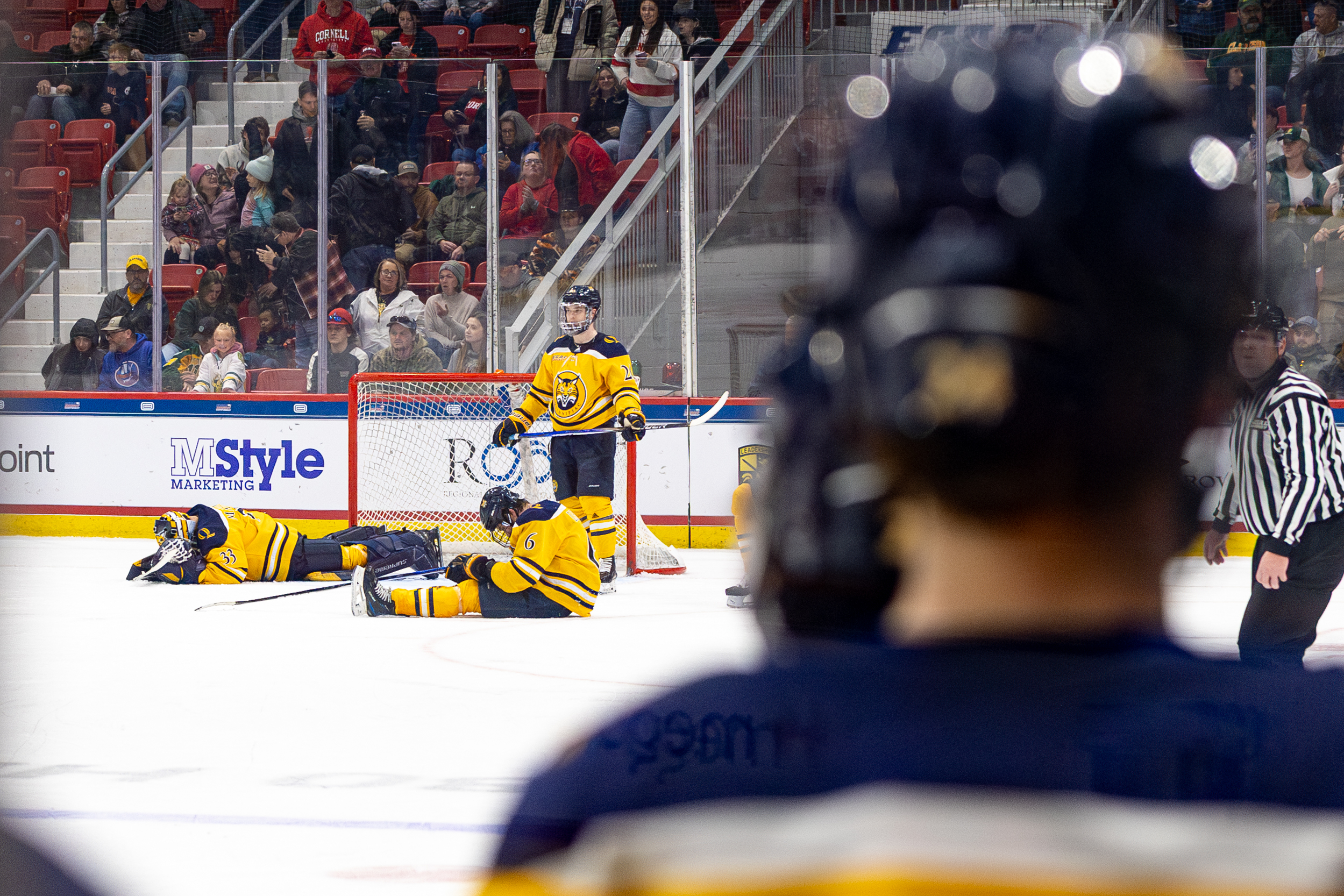
Even with Wyttenbach’s record-breaking season, his team fell in the second round of the NCAA Tournament, losing 5-0 to North Dakota.
The good news for the Bobcats is that Wyttenbach will give it at least one more year before he makes the move to the big leagues. Wyttenbach comes back to a stacked Quinnipiac roster, and he will look to build off his season.
“I mean, we picked up some really good players from the portal, especially a really good goalie. Obviously, we’re gonna have a very good hockey team next year, and it’s really exciting to look forward to next season and kind of see how well we do,” said Wyttenbach.
Wyttenbach might not have received the Hobey Baker Award in 2026, but what does his sophomore season look like?
Quinnipiac finished the season eighth in the United States College Hockey Organization poll, and will try to use that ranking as motivation to get better for next season, with some old and new faces at M&T Bank Arena for 2026-’27.
Quinnipiac women’s ice hockey sophomore goaltender Felicia Frank’s second season with the Bobcats featured broken records and an ECAC Championship.
Frank hails from Falköping, Sweden, and last played for Brynäs IF in the Swedish Women’s Hockey League before her time at Quinnipiac University. She was named best goaltender of the 2023 World Championships after she posted a .895 save percentage and led the Sweden U18 team to a silver medal.
The transition from playing professionally in her home country to the collegiate level in the United States wasn’t easy.
“I had a hard time my first year, especially first semester. It was really hard and I couldn’t like feel like I was myself,” Frank said. “I was just like scared to actually like speak to someone because I was like scared of the language.”
In 2024, the goaltender joined the roster alongside seven other first-years, including her now-roommate, sophomore defenseman Ella Sennick. Frank identified Sennick as a significant support system when it came to adjusting to life in the United States.
“I’ve become way more confident in myself because she is like understanding how I feel. Like if I can’t like explain something, I’m like, ‘OK, wait, I need to think about how to explain this.’ She was like, ‘OK, just take your time,’” said Frank.
Sennick agreed that her relationship with “Frankie” has been a highlight of her time at Quinnipiac.
“With Frankie, like, especially this year, we’ve done, like, every single little thing together,” Sennick said. “It’s just nice to have someone that when we go back to the dorm, like, we kind of take a break from hockey.”
A strong connection built by players can be crucial to building an even stronger team. Members of the current sophomore class haven’t been the only ones supporting Frank since she left Sweden. Athletic trainer Carrie Gaydos saw firsthand the way that the upperclassmen were able to make Frank feel at home.
“When she came to Q, she was . . . for sure homesick . . . that’s where some of the older athletes will step in,” said Gaydos. “They took her to IKEA a lot for like the meatballs and just to have her in a place where she could see some of the words that she recognized.”
Player accountability is prevalent in the program, and the student-athletes go above and beyond to make sure every person feels supported.
“They wanna try and make everybody feel welcome. I feel like they reach out, they do what they can to really make everybody, no matter their background or what they’re facing, as a family,” said Gaydos.
Off-the-ice support is just as important as on-the-ice support. Frank and Sennick must work closely during games since they’re both a part of the team’s defensive line.
Sennick is an integral part of the team’s defensive effort in front of the net. She led the team with 78 blocks this past season in her effort to support Frank.
“I like to hear her side of the things, like her games, like what she saw, because obviously, like, you know, we’re both on the D side of things, but she sees things differently as me,” said Sennick. “It’s like mutual feedback that like, you know, we both take into consideration to kind of, you know, help each other be better.”
The personal relationships and commitments to getting better are major pillars in what the women’s ice hockey team lives by: the team culture.
The time and care that the team invests in its athletes is why Quinnipiac can become a second home for international players like Felicia Frank.
“The type of athlete we recruit is super important. And I think the girls have been fantastic . . . by the time they leave as seniors . . . it’s incredible to see the rate of growth, how beautiful they are, just inside and out,” said Gaydos. “And we really, I think, provide, obviously, a D1 athlete model, but we’re also making them better people.”
Putting students first in collegiate competition gives all athletes the chance to succeed, regardless of the struggles they face.
“I think I’ve grown so much as a person because of the team culture we have. And I’ve become way more confident with the language and academics here. But also, how I play as a hockey player,” said Frank. “I can be myself on the ice and play my own game. And have my team support me.”
From Alaska to New York, Will Gilson has been all over the United States map for his college hockey career. However, to end it off, he chose to play his final season back in his home state of Connecticut.
Gilson is from Old Greenwich, Connecticut, which is about an hour away from the M&T Bank Arena, home of the Quinnipiac University men’s ice hockey team, the very team the defenseman chose for his senior year.
Prior to playing at Quinnipiac, Gilson spent his first two years at the University of Alaska-Anchorage and his junior year at Rensselaer Polytechnic Institute (RPI).
Before his college years, he played for Boston Jr. Bruins (Marlborough, MA), Westminster Prep (Simsbury, CT), and Mid Fairfield (Greenwich, CT)– all teams that played in a close vicinity to his home. Leaving for Alaska was quite the disruption.
As a Connecticut kid, Gilson knew this is where he wanted to be. During his years playing for Mid Fairfield, playing locally at some point within his college years was the ultimate goal.
“You always wanted to play for a school by your state and coming here, the main thought process was they’re gonna be a great team and I wanna go win a national championship and I got a chance to do that here,” Gilson said during a news conference following the team’s win against Maine on Oct. 18. Gilson could not be reached for an interview for this story.
Although the national championship was just out of reach for the Bobcats this year, the team won the ECAC regular season title for the sixth consecutive year and made it to the NCAA regional finals.
A special part about playing for a team in his home state is that the people he grew up with can come support his games. At the final match of the regular season against Harvard, Gilson had a group of friends in the stands to cheer him on. At the end of the game when the trophy came out, they were all at the boards yelling, “There you go, Gilly!”
Joining a new team as a senior meant that he automatically stepped into a leadership role. With the Quinnipiac team, many of the players have had experience being on a team with each other prior to their time in Hamden, but that wasn’t the case for Gilson. The only Quinnipiac hockey players he played with in other leagues already had left the team: Collin Graf, Sam Lipkin and Cooper Moore.
Despite this, he fit into the leadership role seamlessly and was happy to take it on. In fact, being a leader is something he’s been looking forward to throughout the entirety of his college career.
“It’s been a cool scenario, I obviously wanted to be here and then obviously wanted to be a leader kind of everywhere I’ve been, and you know, hasn’t really worked out like that and it works out like that this year so it’s really just a perfect fit,” Gilson said. “I love being a leader and just trying to help out in any way.”
Tyler Borgula, a sophomore forward for the Bobcats, had a lot of praise for Gilson and the rest of the seniors.
“Every single one of those guys impacted me in being a leader,” Borgula said.They inspired me, this team and obviously the community around us. From the bottom of my heart and from everyone else’s heart, these guys mean the world to us; we look up to them and wish them nothing but the best in the future.”
Gilson stepped up as a leader during his year at Quinnipiac and played a major role on the ice. This season, he put up 28 points, including five goals and 23 assists, leading all defensemen on the team in points. That was an improvement from his time at RPI last year, when he led the Engineers with just 24 points.
Photo by Izzy DiBari
His efforts on this team didn’t go unnoticed. As of April 4, Gilson headed to Rhode Island where he was signed for an amateur tryout with the Providence Bruins. Although the future of his hockey career might end up taking him beyond his home state, he still can forever look back on his final year in college hockey where he got to play right here, in Connecticut.
Sophomore forward Chris Pelosi scored his first goal in a month as the Quinnipiac men’s ice hockey team defeated the Providence Friars 5-2 Thursday in an NCAA regional semifinal in Sioux Falls, South Dakota.
Quinnipiac will face the North Dakota Fighting Hawks at 7 p.m. on Saturday night for a chance to advance to the men’s Frozen Four in Las Vegas.
“It was unreal,” said Pelosi after scoring the second goal of the game. “It was a great feeling and kind of brought me back to the good old days”
In the previous series against Clarkson, they recorded one point in both games they lost. Pelosi felt he truly bounced back tonight.
“Our complete level was just different tonight. I don’t think I gave it my all against Clarkson, and it really picked up today,” said Pelosi.
Pelosi has been a standout forward for the Bobcats this season; deemed a leader by the coaching staff despite being a sophomore. However, a challenge of leading is being there and talking to your team. For Pelosi, injury took away part of that trait he possessed. Despite it, he worked to get back and showed how much he means to the team.
Pelosi was a 2023 third-round draft pick by the Boston Bruins, and has served as one of the top players for Quinnipiac the past couple of seasons. His talent, character and diligence doesn’t go unnoticed. It’s something that also has been noticed by his teammate, first-year forward Markus Vidicek.
“Every day he comes in, he wants to work hard and wants to get better and it shows on the ice, and I think he’s gotten better since the season started” Vidicek said.
For Pelosi, there was a time when that hard work came to a halt. In a Jan. 31 game at Clarkson, Pelosi suffered a shoulder injury that kept him out for nearly a month. Injuries might be the worst part of being an athlete. Sitting on the bench or up in the top of the arena while teammates play and have fun while you are stuck watching isn’t the outcome you look forward to whatsoever.
Pelosi said he “was getting bored” of watching the games. He wanted to get back out on the ice and play hockey. Despite the boredom and itch to get back on the ice, Pelosi found the injury as both a good and bad thing.
“Yeah, it’s always fun watching the team from an outside perspective,” said Pelosi. “We’re so good and so skilled, so it’s kind of refreshing to see when you’re watching from the stands. But, it got kind of boring up there, watching the boys blow out these teams, set new [home] records, and so I was a little bit upset while I was out, but at the same time, I was happy the boys were keeping it rolling and getting the wins.”
It was rough for Pelosi, and came at a tough time for the team. Quinnipiac was on its furthest road trip of the season, in Potsdam, New York. Nearly five hours away from Hamden. Pelosi wasn’t the only injured Bobcat, either. His roommate, sophomore forward Tyler Borgula, also missed time – which helped Pelosi.”
“You can’t lift with the team, so you lift as an injured crew and you can create your own jam that way, so it was fun with the injured guys,” Pelosi said, “but at the same time we were all battling to get back as soon as possible.”
Pelosi said that the teammates he lived with helped make sure he was OK.
“Borgula was injured as well with a broken wrist, so we kind of had [Andon] Cerbone and [Matthew] McGroarty doing some stuff for us,” Pelosi said, “but, yeah, they helped us out a ton.”
Coach Rand Pecknold missing one of his stars in the lineup, Quinnipiac had an impressive showing, scoring 25 goals in four games.
However, the winning streak didn’t last long. Pelosi was nearly ready to come back as Quinnipiac faced off against nationally ranked Cornell at home. Even though Pelosi was hungry to get out there, he had to sit just one more game, forced to watch from above in a suit, as his team suffered its worst loss at home in over five years, as they were defeated 6-1.
“Cornell always plays us well and gives us a hard game,” said Pelosi. “We came down on the bottom side of that game, but, it lights a fire under the injured guys and the scratches that we have, and it just pushes us even further.”
Pelosi and his team will now look ahead to Saturday. From what has been an up and down season, Pelosi think they are as talented as anyone else in the field.
“Yeah, we know what we’re capable of,” said Pelosi. I think [we are] going into the playoffs with a clear mindset and bouncing back even stronger, and knowing that we could do this thing.”
Sports can be the epicenter of a lot of emotions, excitement, grief, pain, you name it. Any given fan could experience the highest of highs — a monster walk-off home run to win an important baseball game with the crowd roaring in shock and excitement. A fan could also experience the opposite flow of emotions — their favorite basketball team’s star player misses the game winning shot with the season on the line. These things happen all the time in sports, it’s such an unpredictable concept.
You never know what you’re going to see or hear.
This same phrase can be applied when it gets behind the scenes of these athletes. What these athletes do in preparation and the purposeful and intricate actions that they take help them to prepare mentally for their next game or big moment.
“One of the biggest things that people don’t ever really pay attention to in sports is the preparation,” said Dr. Brett Denkin, a licensed sports psychologist based out of Westport, Conn. “It’s easy to see the guy struggle in a batting slump from the TV screen, but what is he doing behind the scenes to fix it? Is he changing his mental approach to the game?”
This is where one of the most intriguing concepts in all of sports come into play – superstition, routine and ritual. Professional sports have been littered with these odd, and often hysterical behaviors for decades.
Speaking of odd and hysterical, former Major League Baseball outfielder Yasiel Puig was well known for hitting home runs, but he was arguably more well known for licking his bat in the batter’s box. This isn’t necessarily mundane for any baseball player, but according to Puig, he the bat gave him extra energy needed to hit the ball.
Michael Jordan, regarded as the greatest basketball player of all time, used to wear his powder blue North Carolina shorts under his Chicago Bulls shorts throughout his career, believing it would give him good luck. Leonard Fournette, the fourth overall pick in the 2017 NFL draft, wears his purple and gold pads from his college days at LSU under his jersey throughout every game. It’s often a stark contrast from the colorway on his pro jersey, but all he cares about is the comfort of having those pads on.
Wayne Gretzky, who’s widely accepted as the top pro hockey player ever, refused to cut his hair before a game. He also applied baby powder to his skates before hitting the ice. It may be hard to see how this could help an athlete’s performance, but it’s not all about what happens in the game.
“A lot of these behaviors stem from some from of performance anxiety,” said Dr. Denkin. “Doing these things either before or after the game can help to calm the athlete, get them in ‘the zone’ or even to shake off the rust after a bad game.”
These, often unusual, superstitions are not personal to the athlete. High school basketball games are notorious for these types of things. Any time an opposing player is shooting free throws, the home crowd is likely doing anything they can to try and make them miss.
“The superfans here love to wiggle their fingers as the court falls in silence, that’s been a staple in our gym for years,” said Bob Rodgers, the athletic director and boys basketball coach at Whitman-Hanson High School in Whitman, Mass.
When the home team is losing in a baseball game, fans are often seen all over the park flipping their caps inside out, then placing them on their head upside down. This is called the “rally cap” and in theory, it sounds wacky. But fans will do anything they can to try and get the outcome they’re looking for, much like the athletes.
One Quinnipiac baseball player absolutely needs to listen to his country music playlist before any game, or his entire day will be thrown off.
Knox at Nichols College in 2024 – Courtesy: Nichols Athletics/Michael Mason
“I listen to Riley Green before every game,” said Johnny Knox, a graduate infielder for the team. “I have a whole playlist filled with country [music] that I have on before and after my games. It just puts me where I need to be mentally, so I’ve continued to do it.”
While this may not be the most outlandish thing done by an athlete, Knox admits that he’s seen weirder.
“I’ve seen people spit on their batting gloves at the plate,” said Knox. “I’ve seen guys that slap themselves in the face before running onto the field. I’ve seen some pretty wild things, but they all have a purpose for the people that do them. These things get them ready to play, so I guess it’s worth it to have something like that to do, as long as it works.”
According to a study by Cognition Brain Behavior, around 55% of athletes at any competitive level participate in a routine or superstition, while close to 70% believe that their rituals had an impact on their performance. While there’s still no proven truth that these actions directly impact performance, it’s the belief and comfortability athletes get that allow them to potentially play better.
Courtesy: P8Photos.com/Rob Rasmussen
“My teammates and I juggle together before every game. We’ve been doing it since I got here and it just gets me prepared to play,” said Milena Branco, a junior midfielder for Quinnipiac’s soccer team. “If there’s a time where we don’t do it, I’m thinking about it all game. If I make a mistake, I almost wonder if that’s why.”
Women’s soccer at Quinnipiac has been on a roll the last few years, winning back-to-back MAAC titles in 2022 and 2023, and finishing as the runner-up in 2024. While the success likely isn’t directly linked to any superstitions around the team, the whole roster is aware of it.
“I grew up playing with a girl who would meditate on the field before every game,” said Branco. I also used to play with someone who would roll her jersey sleeves up with her shorts rolled up too. I never understood why, but I guess it made her feel comfortable in game.”
The sport of hockey is one of the most superstitious sports in the world, and Gretzky’s antics are just a fraction of what you can see around the game.
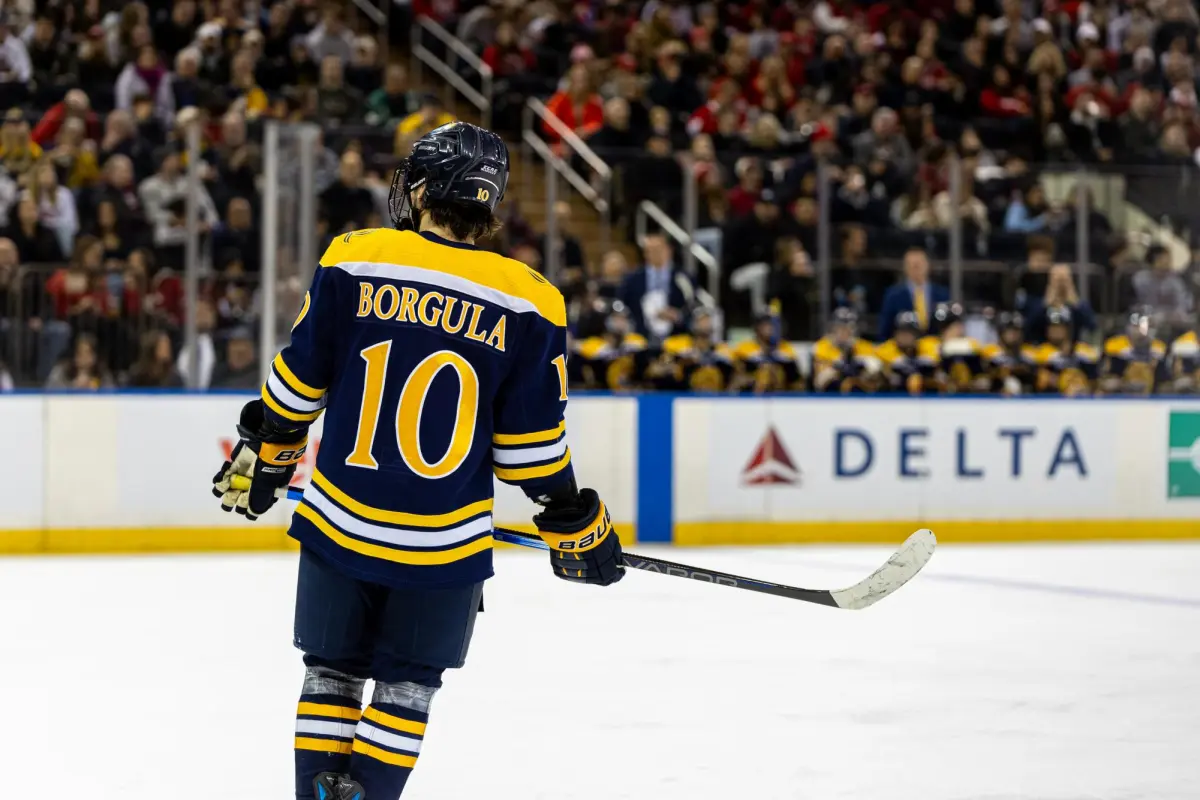
First-year forward Tyler Borgula of the Quinnipiac Bobcats ice hockey team is one of the most superstitious athletes at the university. What’s unique about him is that he doesn’t take part in one or two pre-game actions, he plans his day out ahead of time and he sticks to the same schedule every game day.
Courtesy: Quinnipiac Chronicle/Trip Menhall
“I’m waking up the same time every game day, around 8:00 or 8:30 a.m.,” said Borgula. “We’ll go to the rink and eat our breakfast. I get the same thing every day. Then we’ll pre-game skate.”
Borgula, along with the rest of the hockey team, gets Whitney Donut catered to the arena for game days. He goes for the classic bacon, egg and cheese, something he admits is pretty basic, but it puts him in the right headspace. At lunch, he’ll eat at Eli’s, a nearby restaurant in Hamden. He gets chicken and pasta with butter, something he’s done for the last four years.
Much like Knox, he also listens to a playlist before every game, but with the same songs in the same order. The playlist mostly consists of rap artists Meek Mill, Travis Scott, Gunna and Eminem. However, he admits that sometimes a song gets skipped, or even swapped out where a new song will take its place.
“Following a strict regiment can help a given athlete keep structure, which in turn limits out of character behaviors,” Denkin said. “If you don’t play great the next game, and it really eats away at you, you can always fall back into a comfortable environment that you’re used to, and in the environment you feel confident and familiar.”
This kind of routine runs deep, and Borgula admitted that he’s been doing this same routine, with a few minor additions and subtractions along the way, for over two years now.
“My first year of juniors is when I kind of started to realize that I needed to build a routine instead of just showing up. Moving away from home and being on my own definitely helped me develop it,” said Borgula.
However, some days he’ll miss a step of his routine, and this small missed step truly takes a toll on his mind.
“Some days I’ll forget to play the same song or something like that, and that kind of messes with me, which it shouldn’t. I guess it’s just my personal superstition, but I try not to let it get to me too much,” he said.
Borgula also cited that he tapes his stick from heel to toe, but will change it up if he deems that he had a bad game, switching to toe to heel.
“When I do this [routine], I truly think that it helps me and keeps me staying focused for the games,” the Michigan native said.
He also labeled pro athletes like Jordan and others as an inspiration for his routine.
“I’ve watched so many documentaries on Kobe, or Lebron and Jordan, and even watching the NHL day in and day out. These guys all have their own thing to be able to perform to their best, and I think that’s what I want to strive towards,” said Borgula.
This routine has worked out rather well for Borgula in his first year at Quinnipiac. He netted 12 goals and assisted on 13 more for 25 points in 38 games played.
“Over time, these things just melt into athletes’ brains,” said Denkin. “These oddities you see on the TV almost always start way before the pros. It’s something that athletes carry on with them for years, because it makes them feel comfortable in uncomfortable situations.”
The old saying “feel good, play good” is seemingly accurate for Borgula, Branco, Knox and a multitude of other athletes across the globe across all levels.
From the fan who’s sitting in their recliner at home watching a game, these things may always seem like edgy, selfish things that players do to attract attention from the press, but in reality, it’s much deeper than that. Forgetting to do the things that they do before or after every game or match can really affect the mindset of an athlete.
“As long as these behaviors aren’t harmful to anybody, these are great for sports. Having a personal tick that gets your body to get serious when you need it to is a fascinating thing, and I personally love to see these all throughout sports,” Denkin said.
To become a Division I athlete, the journey and the path to get there is a long one that varies from athlete to athlete. Different sports have different paths to ultimately get to the collegiate level. In some sports that pathway starts early on, and for other sports that pathway develops later. While that goal and ambition for these athletes remain the same, the process of getting there is not consistent.
Recruiting in college athletics has never followed a one-size-fits-all model, but the differences in recruitment between sports have only continued to widen with the nature of college sports today. In some sports, attending camps and showcase tournaments early on in middle school and high school are required. For other sports, athletes discover opportunities later in their high school careers, often through informal connections, or high school sports. In less well-known or emerging sports, recruiting remains a player-led process, built on highlight videos and reaching out to coaches.
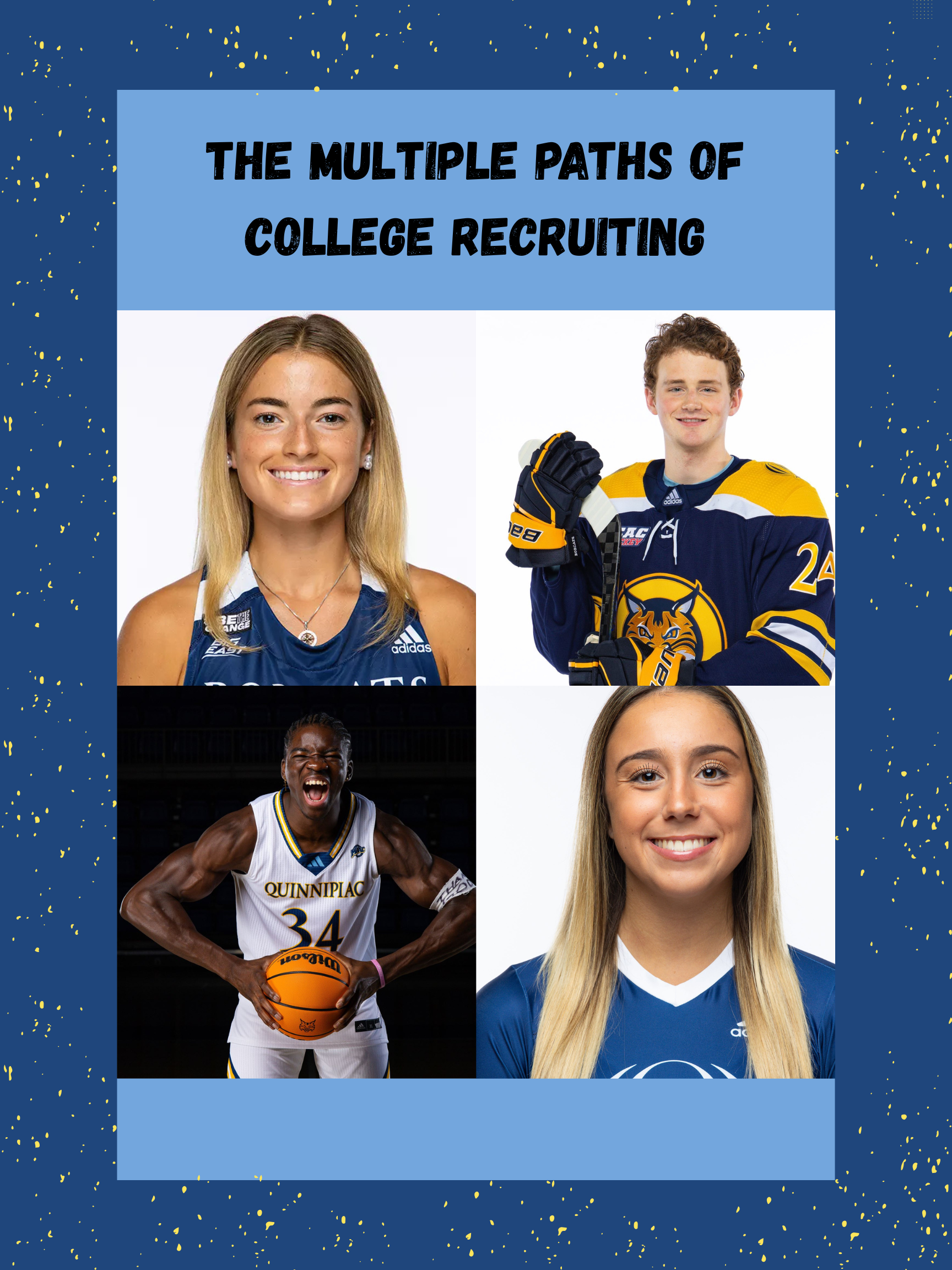
The recruiting journeys for athletes from various teams at Quinnipiac University highlight how different recruitment can look even at the same school. Through the stories of athletes in men’s hockey, field hockey, men’s basketball, and acrobatics & tumbling at Quinnipiac, it shows how the process to earn a roster spot in Division I athletics is a long road with many ups and downs.
Different Sports, Different Timelines
An athlete’s recruiting journey can often define the rest of their college pathway. But the question of when that process starts and what it looks like depends heavily on what sport they play and their background in that sport.
Hockey: Early Exposure, Long Waits
For men’s hockey, committing early is common, many hockey players are scouted through showcases in ninth or tenth grade or through junior hockey programs and national tournaments. The hockey recruitment path relies heavily on early development leagues like the USHL or prep school circuits, which act as pipelines for Division I hockey programs. Hockey players are usually scouted many years before they step foot on a college campus.
However, even early commitments don’t mean immediate arrivals on those college campuses. Many players will go to play juniors after high school because they aren’t physically ready for the pace of college hockey yet. The college hockey path is a long one and the dream is oftentimes developed early.
Quinnipiac Athletics
For Alex Power, a junior on Quinnipiac’s hockey team, the dream of playing college hockey started as early as he can remember. Growing up in Canada not playing hockey was not really an option and he always looked to play at the next level. When he was in prep school, he was faced with a decision familiar to many Canadian hockey players: pursue the major junior route or aim for NCAA hockey. Power was drafted to a major junior team and attended their camp when he was 16, but he already knew the path he wanted to take.
“I always pictured myself playing college hockey, from there, I just took steps that would move me closer to that goal,” Power said.
That path did not lead him right to college hockey. It first led him to junior hockey, where he played for two years after high school. For Power, this time was a critical step on his journey, for development and for gaining exposure to college programs. His breakthrough came during a showcase event early in his second year of juniors, where all the teams in the league played in a showcase in front of dozens of NCAA scouts. That’s where he caught the attention of Quinnipiac assistant coach Mike Corbett.
From there, the process was a slow build. Conversations began casually with check-ins and gauging interest. As Power started stringing together good play on the ice the talks turned serious.
Two months after the showcase, Power took the next step on his path and committed to Quinnipiac. And while official visits are common in many sports before committing, he never made the trip to Hamden before his commitment.
“I talked to people who had been here, and everyone had great things to say, I trusted what I’d heard and seen,” Power said.
While every athlete’s story is different, Power’s recruiting journey is considered “typical” in the world of men’s hockey, especially for Canadian players. The process is a long one, often starting years before the athletes ever arrive on campus. Exposure depends heavily on showcase events and performance in juniors, and most players don’t commit until they’ve proven they can handle the pace of play at the next level.
That lengthy timeline, though necessary, can be stressful. Power recalls watching other players commit ahead of him and wondering if his opportunity would ever come.
“Pretty much everyone in my class was committed before I was,” he said. “It wasn’t jealousy it was more just wondering, ‘Is this ever going to happen for me?’”
In the end, it did. And for Power, it was a reminder that the recruitment process doesn’t need to be rushed, just trusted.
Power’s story fits into the broader trends of men’s college hockey recruiting, especially for players navigating the decision between NCAA hockey and the major junior route. In hockey, early exposure is typical, but it rarely guarantees an immediate result. The recruiting process can include many stages: youth leagues to juniors, junior leagues to showcases, and finally, a college commitment. For most players like Power, it’s a long winding path. Junior hockey serves as both an in-between and a development stage, where athletes physically and mentally prepare for the demands of Division I. Power’s journey emphasizes how the timing and direction might not look the same for every athlete, but the destination that the path leads can be the same.
Field Hockey: Early Outreach and a Positive Payoff
For sophomore Quinnipiac field hockey player Katie Shanahan, the dream of playing Division I field hockey started earlier than most of her teammates. In eighth grade she was already thinking about her future, she was determined to find a place to play at the next level. She wasted no time in getting started.
Quinnipiac Athletics
“I emailed about 45 schools. I was young and didn’t know exactly where I wanted to go or what level I’d end up playing at. But I’m a go-getter and I just wanted to start putting myself out there” she said.
When she was in 8th grade the current NCAA rules prohibited coaches from contacting players until June 15 of their junior year of high school. That left a long stretch of waiting after sending emails and attending clinics, without much feedback to gauge where she stood. These clinics were held by different colleges, and they played a key role in keeping her name in the mix with the coaches.
She explained how college field hockey coaches don’t really come to high school games, especially for players like her playing in the public school system. So, these clinics and showcases were the best way to get seen before that period where coaches could finally contact them.
When that June 15th date finally arrived, she took the day off from school just in case the phone might ring, she really had no expectations going into the day.
“I got my first call at 8 a.m. from Princeton,” she recalled. “It was a little nerve-wracking because I didn’t know who would call, or if anyone would, but as the day went on I received eight phone calls.”
She heard from some schools with better programs on paper but already had a favorite in mind. Having attended clinics at Quinnipiac since eighth grade, she felt a strong connection with the coaching staff that made her feel at home.
Two weeks after receiving those initial phone calls, she made it official and committed to Quinnipiac. Her path would take her from Massachusetts to Connecticut.
She committed very early on in the process and that came with its own challenges.
“I was one of the first 10 to commit in my class in the area,” she said.
Her early decision to commit very early came with both perks and challenges. For almost seven months, she was the only player from her recruiting class at Quinnipiac to commit, which felt a little isolating.
Not only was it isolating it also caused her peers to question why she didn’t want to weigh her options and see if she could draw attention from bigger schools.
“My teammates from high school and coaches would say, why didn’t you go there? Why didn’t you go there? When I told them about my commitment,” Shanahan shared.
But for her, the choice wasn’t about chasing the biggest conference or athletic department, it was about finding the right fit.
“I’d rather pick a school that I love than a school that’s ranked just for the name,” she said.
The Quinnipiac culture, coaching staff, and campus environment all aligned with what she envisioned for her college athletics experience.
Shanahan’s recruiting journey was different because she did not take the wait-and-see approach that many athletes in her sport take. She proactively emailed dozens of coaches before high school and worked hard at many different clinics which directly translated to her receiving early offers. While Shanahan’s early and proactive approach to her recruitment helped her secure a Division I spot, not every athlete’s journey follows such a straightforward path.
Basketball: The Importance of the Late Push
For Akintola Akinniyi a sophomore on Quinnipiac’s basketball team, basketball was never just something he did for fun, it was his steppingstone. Growing up with athletic promise in Texas, people told him that he had the tools to make it and he aimed to prove them right. From the very beginning his goals for where basketball could take him were high.
Quinnipiac Athletics
“I wasn’t even thinking about college. I was thinking about the NBA, and I knew college was just part of that path” he said.
However, the path hasn’t been as simple as he once anticipated. His journey in the recruiting circuit began as it does for many talented basketball players with AAU hoops. He participated in tournaments held on weekends during and in the summer that drew scouts and coaches from around the country.
The thing that mattered the most from these tournaments was getting the all-important “write-ups”. Write-ups are short scouting reports written by scouts evaluating a player’s skills and potential. Akinniyi remembers getting his first one in eighth grade, it was a validation that he was on the right path. More write-ups continued to roll in, especially after strong performances at summer events leading to interest and offers.
“AAU makes your money, that’s what gets you the offers, the write-ups, the rankings” Akinniyi explained.
Despite opportunities to play at a prep school like many of the top players his age, Akinniyi chose to stay at his public high school for all four years. This decision kept him closer to home but may have slowed his recruiting process. His first Division I offer didn’t arrive until late in his senior year, just three days before his graduation. He felt pressure to commit because it was so late in the game, so he committed to Army.
The transition to a service academy proved challenging for him. The military regiment just wasn’t what he was looking for. By the fall of his freshman year, he decided to step away from the team and enter the transfer portal. This decision was a risk because he didn’t want to give up on basketball entirely but knew there could also be limited interest in the portal.
“It’s a leap of faith,” he said. “There’s thousands of people in the transfer portal, and not everyone makes it out.”
Similar to Power, Akinniyi also felt a lot of pressure and jealousy when he saw the things his AAU and high school teammates were doing at nonservice academies. He also had a hard time accepting that Army was where he was supposed to be.
“I was very envious. When I was at Army and seeing other people at other schools, obviously non-service academies I was very envious, very jealous. And it was kind of like, dang, what am I doing wrong?” Akinniyi said.
That self-doubt and desire to do more did not defeat him, he used it as motivation to change his setting. Akinniyi didn’t want his path in basketball to be over, so he emailed several programs in the middle of the semester hoping for another opportunity.
The timing was right, Quinnipiac was searching for a forward after suffering some injuries. He emailed them and heard back the next morning. He visited campus during Thanksgiving break and accepted their offer, officially enrolling on his 19th birthday. The next stop on his path led him to Connecticut.
His commitment to Quinnipiac was the next step towards his long-term goal but getting there did not come without roadblocks and stress.
“It’s very stressful, because you just don’t know what your future entails. You don’t know what’s going to happen. Especially for me, I’m at Army and it’s like if I don’t find an offer, I’m going to have to stay here. I’m going to have to stay in the Army”.
Akinniyi’s journey is an example of how chaotic and uncertain the recruiting and transfer process can be. Recruitment is a long road and although every athlete and sport has differences in what it takes to play at the Division I level, similarities do exist as well.
Akinniyi’s story isn’t considered an outlier, it’s a reflection of how modern college recruiting has evolved and the evolution of the transfer portal. The path to a Division I roster spot today is rarely the same.
In addition to recruitment, many athletes’ paths include navigating the transfer portal, which has reshaped the recruiting landscape in the last five years. The transfer portal was always used as a fallback option, but it is now a key part of how coaches build rosters and how players find new opportunities.
His decision to bet on himself and re-enter the recruiting circuit is something more and more athletes are doing. Like so many other athletes navigating this new recruiting environment, he learned that sometimes the journey takes detours before it arrives at the right destination.
Acrobatics & Tumbling: The Emerging Path
For junior, Quinnipiac acrobatics and tumbling athlete Ally Murray, the road to college athletics didn’t begin in a recruiting database or at a national showcase. It started through a casual conversation. A family friend who was a former college football coach mentioned a unique fast-growing NCAA sport that combined gymnastics, cheerleading, and team-based stunting. It was a path she knew nothing about and hadn’t considered going on.
“I was a gymnast my whole life,” she said. “I think going into college I wanted to still be an athlete, but I also wanted a change.”
The more she researched acrobatics & tumbling, the more it made sense for her. It offered her the chance to keep competing at a high level while joining a sport that had a larger team approach in a way she never had while competing in gymnastics. The recruiting process, however, looked different than it did for many of her friends in other sports. Rather than campus visits and showcases, her recruitment was built on emails, online questionnaires, and video submissions of her gymnastics routines.
“For me, my recruitment was all videos, I think now there are showcases, but at the time it was just film from my meets,” Murray said.
After looking more closely at different programs Quinnipiac quickly became her top option. From the first email reply to the initial phone call, the program stood out. As conversations progressed, she set aside other schools and focused her attention on the Bobcats. When she finally arrived on campus for her official visit, the decision was easy.
“All of my current friends now, we were on the same visit,” she said. “We bonded so fast. Meeting those girls and seeing how close the team was, I knew it was going to be a family.”
Like many acro athletes, Murray’s experience comes from competitive gymnastics. The transition to a team-based sport came with challenges. Learning to stunt and being on top of a pyramid was a new experience after years of competing alone.
“The hardest part was working with other people, in gymnastics, it’s just you. I wasn’t used to having to rely on someone else or have them rely on me” Murray said.
Even the equipment was a change. While gymnastics routines take place on a spring floor, acrobatics & tumbling is performed on what athletes call a dead mat, with no bounce to assist in tumbling passes. But with experience, hard work, and adjusting on the fly she made the necessary adjustments quickly.
As the sport continues to evolve, so does the interest and the diversity of the athletes that make up the team. Many of these athletes come from gymnastics, others arrive with cheerleading or even club acrobatics backgrounds. Quinnipiac’s roster reflects that mix, which is something that made her feel less behind when starting the sport in college.
Though the recruiting process wasn’t as high-pressure as what athletes in sports like hockey or basketball experience, it came with its own challenges. Waiting for emails, wondering about follow-up calls, and learning how she could fit into the sport. But ultimately Murray was grateful for how it all unfolded.
“It wasn’t super stressful for me, once I knew this was where I wanted to be, everything else fell into place,” she said.
What began as a casual chat with a family friend turned into a new athletic identity. This new identity allowed her to stay competitive, discover a team culture, and participate in one of college athletics’ fastest-growing sports.
Paths Aligned
With all the different recruiting paths and how different the starting points were the ultimate destination was the same. Powers was chasing his junior dreams in Canada, Shanahan was actively searching for the right fit, Akinniyi was chasing write-ups and late-night transfer portal emails, and Murray was sending tumbling videos to coaches in a sport she was still learning about. For all four of them, their separate winding paths eventually intersected in Hamden, Connecticut.
Across these four sports, the recruiting timelines couldn’t be more different. In hockey, commitments are early and often long-term. For field hockey, it’s all about clinics and trusting the process. In basketball, recruiting can be quick, fluid, and dependent on late exposure. In acro & tumbling, it’s about discovery and outreach. The similarity? It is difficult to navigate these pathways in a college sports environment that is constantly changing.
The stories of Power, Shanahan, Akinniyi, and Murray, make one thing clear: there’s no single path to being a collegiate athlete. Each athlete’s recruiting experience was shaped by both their individual talent and the experience and resources required of their sport.
College athletics offers many opportunities for student-athletes. The systems that deliver these opportunities are evolving rapidly, and with it so are the steps the athletes must take. The paths may look different from sport to sport or even player to player on the same team, but they can all eventually lead to a similar destination.
It’s game day at the M&T Bank Arena in Hamden, Connecticut.
Workers arrive five to six hours before puck drop or tipoff to ensure everything is ready for the students and fans. Their goal is to create an experience that makes people want to return.
For a 7 p.m. game on a Friday, staff members typically arrive around noon or 1 p.m. At that time, the arena is mostly silent. The faces are familiar, and the atmosphere is all business. Workers hustle across all three levels of the arena to prepare for the flood of fans soon to arrive.
The mid-level is the hub of activity. It houses the lobby, ticket office, concessions, and marketing offices. This level also leads to the Lender Basketball Court on the left and the ice hockey rink on the right. Below that are the locker rooms—for home and visiting teams, youth teams, and referees—as well as the gym, press room, and facilities offices. Upstairs is the University Club, where boosters gather pregame, and the media level, home to the broadcast team, student media, and the game operations crew managing music, the video board, and public address announcements.
The marketing team is constantly on the move, setting up contests for intermissions during hockey or media timeouts and halftime for basketball. Downstairs, players stretch and prepare their bodies in the gym. Nearby, the television crews are prepping in the studios, while concession workers haul supplies from the lower kitchens up to the lobby stands to ensure everything is ready before the gates open. They are also in charge of the pre-game table in the lobby, giving out Quinnipiac gear and the post-game signings from the players. They are one of the first to get into the Arena and one of the last groups to leave.
Doors typically open an hour to 90 minutes before game time. At Quinnipiac, that depends on how many fans are waiting and what the weather is like. If it’s cold or rainy, staff often open the doors a bit earlier. Once fans are allowed inside, the mood shifts. The staff is still working at full speed—but now, thousands of people are inside, and that changes everything.
“On a big gameday, people are super excited about what the day is going to be like,” said Quinnipiac University Athletic Director Greg Amodio. “There is nothing better than when we get that occasional Friday night game, and we load up with a bunch of promotions and specials, and the place is packed. At the end of the day, it should be a student-based initiative, that’s what we are trying to build for the community.”
Big crowds
The ice hockey rink has a capacity of 3,625 fans. On February 21, 2025, it was packed for one of the biggest games of the year: Quinnipiac vs. Yale in the “Battle of Whitney Avenue.” The Bobcats won for the 17th consecutive time, a victory that reinforced the heated rivalry between the two nearby schools.
“Playing in front of a sold-out arena is definitely one of the best things about hockey,” said Quinnipiac men’s ice hockey goaltender Noah Altman. “As you grow up and start playing at a higher level, the crowd ramps up. When you’re playing well, it almost feels like you’re in control of the entire arena. It’s so special knowing thousands of people’s days rely on your performance. There’s pressure, but I’ve always played my best when the crowd is big and loud—it helps me focus.”
Photo provided by Quinnipiac Athletics.
For a game like this one, preparation starts from the moment the season schedule is released. The fans are just waiting on the tickets for this match-up up and tickets go out fast.
“The general public will buy those usually during the first two days after we start selling them,” said M&T Bank Arena Executive Director Eric Grgurich. “We sold out on those, and then we only have the student tickets. When we release the student ticket, it’s like our Super Bowl, where they go in under two minutes, 1,400 tickets will be gone.”
On the other side of the building, the Lender Basketball Court holds up to 3,570 fans. The Quinnipiac men’s basketball team has won the regular season title two years in a row, driving up attendance and enthusiasm. On February 28, 2025, the Bobcats faced Saint Peter’s on ESPNU. The arena was sold out, and the energy was electric. The game had extra meaning: Quinnipiac was seeking revenge after falling to Saint Peter’s in the conference semifinals the year before—part of the Peacocks’ run to March Madness.
Photo provided by Quinnipiac Athletics.
Big crowds aren’t new to Quinnipiac. The school has hosted marquee events, including the NCAA Women’s Ice Hockey Frozen Four in both 2014 and 2019.
“My favorite was the second one,” said M&T Bank Arena Executive Director Eric Grgurich. “We executed better because we knew what to expect from 2014. It was really cool—we sold out the championship game both times, and for the second one, we even had standing-room-only. We worked with departments all across campus to pull it off, and it came out fantastic.”
That 2019 tournament featured powerhouse programs: No. 1 Wisconsin, No. 2 Minnesota, No. 4 Clarkson, and No. 6 Cornell. In the end, the Wisconsin Badgers lifted the national championship trophy with a 2-0 win over Minnesota.
Dual-Use Facilities
Quinnipiac has one of the few dual-use facilities in the NCAA. The M&T Bank Arena houses two separate venues under the same roof. While other colleges like Holy Cross, UMass, or Army West Point use the same floor to transition between a basketball court and an ice rink, Quinnipiac’s advantage is that both sports have their own dedicated spaces.
Facilities like the Lenovo Center—home to NC State University’s men’s basketball team and the NHL’s Carolina Hurricanes—also operate under one roof, but they share the same surface for both sports. This requires both teams to carefully coordinate schedules.
Fan Experience
“We are always trying to make sure it’s a safe event for everybody,” commented Grgurich.
Fan experience is crucial in college sports. It plays a significant role in driving ticket sales, strengthening connections with fans and communities, and enhancing the overall success of athletic programs.
For a mid-major like Quinnipiac, winning the 2023 NCAA National Championship in men’s ice hockey has significantly boosted fan engagement. Merchandise featuring the championship team remains popular, and the atmosphere at games reflects that enthusiasm.
Every game at the arena includes at least one or two fan contests, mostly involving students. Whether it’s dizzy bat, a trike race, or the blue line battle, fans compete for prize packs featuring Quinnipiac athletic gear. Depending on the game and contest, prizes can be even more substantial. For example, the half-court shot contest during the 2024–2025 basketball and hockey seasons awarded Avelo airline tickets.
Quinnipiac is relatively small compared to larger institutions like UConn, Syracuse, or Clemson, which tend to draw more students to games. So, how does Quinnipiac keep its fans engaged?
One challenge is the arena’s location. M&T Bank Arena is situated on the York Hill Campus, which houses mostly junior and senior students within walking distance. However, the main campus—Mount Carmel—is home to the majority of underclassmen, who must take a shuttle to reach the arena. The shuttle service is managed by an outside company, Valet Park of America, meaning the athletics department has no control over routes or schedules on game days.
Another important factor is rivalries. Quinnipiac is a member of the Metro Atlantic Athletic Conference (MAAC) and frequently competes with strong programs like Fairfield and Sacred Heart, both of which are geographically close and athletically competitive.
“The university should do a better job of promoting rivalries,” said Quinnipiac junior James Nolan. “Fairfield and Sacred Heart are local schools that we’re always competitive with. I’d love to see that narrative played up more.”
A more nationally recognized rivalry exists with Yale, stemming from the 2013 Men’s Ice Hockey National Championship in Pittsburgh, where Yale defeated Quinnipiac 4–0. Since then, the two teams have met regularly, with Quinnipiac dominating the series, winning all but two games. Quinnipiac has also built a strong rivalry with ECAC opponent Cornell. Since 2001, the two programs have faced off 55 times, with Cornell holding a narrow edge: 28 wins to Quinnipiac’s 21, along with six draws.
Late in the evening of March 21, members of Quinnipiac’s men’s hockey team wandered the streets of Lake Placid, New York, in a daze. Others huddled in crowded booths at The Pickled Pig, a restaurant in the shadow of Herb Brooks Arena, where several truths loomed large.
The Bobcats late ECAC Semifinal collapse against Cornell a few hours earlier was the eighth-straight season they’ve bowed out of the conference tournament empty handed, a legacy of disappointment familiar to everyone in attendance.
And this time, it might have cost them an NCAA Tournament bid.
See, unlike every other NCAA tournament, no sense of mystery accompanies Selection Sunday in hockey. By Saturday night, every team knows if they’re in or out. The fate of at-large bids lies not with a committee, but with math. And Quinnipiac’s formula was slightly off.
The Pairwise Comparison System (commonly referred to as the Pairwise), was adopted by the NCAA Men’s Ice Hockey Committee in early 1990’s as an objective method of comparing teams, and was picked up by the women’s ice hockey committee when it became an NCAA championship sport in 2001. In the early 2000’s it began to be used as the sole determinant of at-large bids in both tournaments. That methodology has continued into the present day.
16 teams make the men’s tournament, each of the six conference tournament winners receive automatic bids, the next 10 teams in the Pairwise are the at-large qualifiers.
A team’s Pairwise position is determined by a direct comparison with every other team in three metrics: 1. Adjusted Ratings Percentage Index or RPI, 2. Record versus common opponents and 3. Head-to-head record.
In a comparison, a team is awarded one point for having the higher RPI, one point for the best record vs. common opponents, one point for the best head-to-head record (if applicable) and one point for each head-to-head win.
The team with the most comparison wins is No. 1 in Pairwise, the team with the second most slots in at No. 2 and so on until every team is ranked.
In a world where every conference champion sits within the top 16 of the Pairwise, the last at-large bid is the No. 16 team. But that’s not the reality of the college hockey landscape. Smaller conferences, such as Atlantic Hockey America and the CCHA, rarely put a team within those parameters, meaning their conference champions steal bids from teams on the fringes of NCAA Tournament contention.
This is the Pairwise bubble. It’s where Quinnipiac lived for all of the 2024-25 season.
After sputtering out of the Connecticut Ice Tournament in late January, Rand Pecknold acknowledged that truth.
“14 is probably not getting in,” Pecknold said. “We’ve got to get at least 13 and then we’ll have a really good chance, but it’s not guaranteed.”
Two months later, Quinnipiac entered that semifinal against Cornell No. 12 in Pairwise. A win over the Big Red all but guaranteed a ticket to the big dance. A loss put the Bobcats precariously on the edge of qualification.
Both AHA finalists sat outside the top 16, so the cut line began at 15. Quinnipiac was the only ECAC team in the top 16, so its semifinal loss moved the line to 14. Minnesota State, champion of the CCHA, owned that No. 14 spot, so the cut line was 13 as the evening turned to night.
If one of No. 16 Arizona State or No. 18 North Dakota won the NCHC, the cut line moved to 12. A Clarkson win over Cornell in the ECAC Championship the next night would push Quinnipiac down to No. 13 and out of the NCAA Tournament.
Both Arizona State and North Dakota lost their NCHC semifinal bouts. Cornell beat Clarkson. Quinnipiac hung on to the No. 12 spot and earned its sixth-consecutive tournament berth — barely.
“It’s not easy to come to the NCAA Tournament,” graduate student forward Travis Treloar said.
Such is life on the bubble. A couple of decimals points were the difference between playing for a Frozen Four berth and getting a head start on the offseason.
The same separated the Bobcats from a different first round matchup, a regional opponent other than red-hot in-state rival UConn, who dispatched Quinnipiac 4-1 with no issue in its tournament opener.
One late loss turned into a win — or a win becoming a loss, and the Bobcats tournament path, and potentially their ultimate fate, looks quite different.
Here are seven different scenarios from the 2024-25 season that could have majorly altered Quinnipiac’s trajectory.
If Quinnipiac…
(No Scrollbar)
…wins the ECAC Tournament
Pairwise PositionNo. 10 (+2)
First Round NCAA MatchupNo. 7 BU in Toledo
By hanging on to its late lead against Cornell and winning the ECAC title the next night, Quinnipiac takes the place of Ohio State against BU in Toledo. The Terriers rolled over the Buckeyes 8-3 en route to a national championship game berth, but Quinnipiac boasted a better defense (2.2 goals allowed per game vs. 2.7) and offense (3.6 goals per game vs. 3.2) so who is to say what might have happened?
…sweeps Maine on the road
Pairwise PositionNo. 9 (+3)
First Round NCAA MatchupNo. 8 Providence in Manchester
Quinnipiac dropped two one-goal games (2-1, 6-5 in overtime) at Maine in October. Winning those games sets the Bobcats up for a Hockey East battle in Manchester against Providence. The Friars — who Quinnipiac has not faced since a 2014 NCAA Regional Semifinal — shriveled in their first NCAA appearance in six years against Denver, losing 5-1.
…beats New Hampshire and Northeastern
Pairwise PositionNo. 8 (+4)
First Round NCAA MatchupNo. 9 Providence in Manchester
Quinnipiac’s most embarrassing regular season losses were the games they dropped to UNH and Northeastern on home ice. The former came just one day after the Bobcats throttled the Wildcats 8-2, the latter was a 5-1 drubbing where Quinnipiac could not keep up. Winning either of those games pushes the Bobcats to No. 10 in Pairwise and a date with BU in Toledo, winning both bumps them to No. 8 and the home team against Providence in Manchester.
…wins the ECAC Semifinal
Pairwise PositionNo. 11 (+1)
First Round NCAA MatchupNo. 6 UConn in Allentown
Beating Cornell in the ECAC Semifinal bumps Quinnipiac up to No. 11, but doesn’t move its bracket position. The committee swapped the original 11 seed, UMass, with Quinnipiac from Fargo to Allentown in the real bracket to avoid a first round Hockey East matchup, so if this were the reality, the Bobcats would simply stay in Allentown and again face UConn.
…goes undefeated in the ECAC
Pairwise PositionNo. 5 (+7)
First Round NCAA MatchupNo. 12 UMass in Fargo
Quinnipiac won the Cleary Cup by a five point margin, ending the regular season with a 16-5-1 conference record. But if the Bobcats went 22-0, as they did in 2023, they find themselves as the top No. 2 seed, squaring off in Fargo against a UMass team that upset No. 5 Minnesota in the real bracket.
…does not force overtime
Pairwise PositionNo. 13 (-1)
First Round NCAA MatchupNo. 4 Western Michigan in Fargo
Quinnipiac pushed four of its regular season losses to overtime, a fact that factors into Pairwise calculations. Had they lost any of those games in regulation, the Bobcats would have fallen to No. 13 and a matchup with eventual national champion Western Michigan in Fargo.
…loses any other game
Pairwise PositionNo. 15 (-3)
First Round NCAA MatchupOut of tournament
The margin for error was so slim for Quinnipiac (less than .005 RPI) that just one more regulation loss to any opponent on its schedule would have pushed the Bobcats to No. 15 and out of the NCAA Tournament. In this scenario, Michigan receives the last at-large bid.
For junior outfielder Mary Fogg, music—like softball—is an outlet for expression.
In a sport that is primarily mental, Fogg uses music to focus. It’s a natural part of her pregame preparation, not just blocking out distractions or serving as background noise, but helping her reset.
“Softball is such a game of failure,” Fogg said. “It allows you to kind of regroup in yourself and be like, ‘OK, whatever just happened doesn’t matter anymore.’”
As Fogg steps towards the batter’s box, her walk-up song—Rihanna’s “Breakin’ Dishes”—plays for the crowd. At this point, it’s no longer just a song; it’s a ritual that sets her up for success.
“When you’re about to go up to bat, it’s just, like kind of a song that’ll get you in the right head space, make you feel good and clear your mind.”
But music’s influence isn’t limited to gameday. It extends to Fogg’s routine, including her training along with her team off the field. In Quinnipiac’s weight room, the speakers blare the softball team’s playlist, one that features contributions from the entire roster.
“Music is really important in the weight room, more than at practice itself,” Fogg said. “Everybody’s listening to music that they enjoy and that will bring their spirits up if their song plays, and it’s kind of like a little boost in their mood.”
The playlist leans heavily into fun, upbeat rap music—songs the team can sing along to while lifting. Drake tracks like “Rich Baby Daddy” and “NOKIA” are staples.
“It’s usually the songs that you can kind of make fun of in a way and make jokes out of,” Fogg said.
But for Fogg, music isn’t just about the preparation for competition—it also helps her find stability in what she calls “a game of failure.” Whether it’s after a rough inning or a bad sequence of events in a game, a single song can be therapeutic for her and her teammates.
“If something goes wrong and we all hear a song that we really like, then it helps reset,” Fogg said. “It sets the energy back and gets everybody back on the same page.”
The positive, upbeat music is essential—not just for Fogg, but for the whole team. If the music between innings were slow and sad, players would be down on themselves and remain frustrated.
That’s why Fogg and her teammates look to music that creates joy and a sense of camaraderie.
“One of the main things that we’ve been talking about this year is being able to have your teammates back and really supporting them,” Fogg said. “If they make a mistake, it’s like ‘That’s OK, you’re going to get the next ball, you’re going to do the next play for your teammate.”
If every Quinnipiac athlete added a track to a shared playlist, Fogg said hers would be Rihanna’s “Breakin’ Dishes.”
“It has to be, just because I feel like that’s my song of the year,” Fogg said.
Sophomore forward Kahlen Lamarche doesn’t turn to music for motivation—it’s her way of staying grounded.
“I’m a player who kind of doesn’t want to get too caught up in the game or the moment,” Lamarche said. “Songs take my mind off of a big game or having to achieve something in that game.”
Lamarche’s nearly 10-hour playlist is rich in country music, headlined by popular acts such as Luke Combs and Luke Bryan. The easy rhythm of the genre playing through her headphones is an important part of her preparation before taking the ice.
“They’re loosey goosey,” Lamarche said. “They just allow me to have fun and sing along.”
Songs like “When It Rains It Pours” by Luke Combs and “She’s Country” by Jason Aldean are “must plays” in her rotation. The latter, with its driving tempo, finds its way into her headphones closer to puck drop.
“That’s another big song that I love listening to before games,” Lamarche said. “It’s got an upbeat to it and it kind of just gets me in the zone and dialed.”
Even with a handcrafted playlist of country music that is longer than the average American workday, Lamarche has been surprised by her music. One of the most important songs in her life wasn’t one she was looking for—it found her.
“It was kind of like when you click a song and then it goes on a random queue shuffle,” Lamarche said.
That’s how she discovered “What Are You Waiting For” by Nickelback.
The song’s message about taking action and living in the moment helped Lamarche as the Quinnipiac women’s ice hockey team’s season came to an end, just shy of an NCAA tournament appearance.
“That song showed me that I’ve got to take action for what I want to come next,” Lamarche said. “If I dwell on the past and what happened, like the next steps, next year, won’t ever happen if I don’t come to terms with what happened.”
The song’s impact didn’t end with the 4-1 loss to Clarkson in the ECAC playoffs.
“It resonated with me at that time, and kind of still does,” Lamarche said. “Leading up to next season, I know that I’ve got to work.”
As Lamarche looks forward to next season, she knows exactly what will keep her ready: her music. Though she initially thought about adding a country song to the Quinnipiac athlete playlist, she ultimately decided against it.
“I’ve got to be considerate when adding country,” Lamarche joked.
Instead, she chose “What Are You Waiting For” by Nickelback.
As graduate first baseman Sebastian Mueller takes his last practice swing and leaves the on-deck circle, “Purple Haze” by Jimi Hendrix vibrates through the field’s speakers.
“My dad’s fantasy football team was named Purple Haze because he really likes that song,” Mueller said. “So I was like, ‘You know what? This actually would be a really good walk-up song.’”
As he steps into the batter’s box, Hendrix’s iconic distorted guitar tone reminds him of the music he grew up listening to.
“It’s always been a part of my life,” Mueller said. “Me and my sister joke around, like going with dad somewhere, you got the dad tunes going. That music’s always flying around the house.”
Both a constant presence in Mueller’s life, rock music and baseball are interwoven when he takes the field for Quinnipiac. And when he says “dad tunes,” he means it—Lynyrd Skynyrd, Deep Purple and his favorite, Led Zeppelin.
“I don’t know what it is about their music,” Mueller said. “It’s something I’ve always connected with.”
The connection runs deep. On game days, there’s hardly room for anyone else in his pregame playlist. Led Zeppelin offers exactly what Mueller needs to get in the right mindset.
“Baseball is a sport mentally where you don’t necessarily want to be super jacked up. You want to be fired up, but not too excited,” Mueller said. “So that’s why, for me, I’ve always liked Led Zeppelin music. I just like the zone it puts me in; it’s good for baseball.”
Mueller’s love for music isn’t confined to his headphones—it extends into the team’s culture.
On the team, he’s known as the “music guy,” the one who controls the music at practice and while training. While this task seems easy, Mueller navigates different genres of music to keep the energy levels high among the team.
“Some days it’s country, some days it’s rock, some days it’s Spanish music,” Mueller said. “Certain parts of baseball are not the most exciting, so having some music going to keep guys in a good mood is very helpful.”
And what also keeps the guys in a good mood? Winning. That occasion has its own anthem. After a big win, Mueller breaks out “Heartache Medication” by John Pardi.
“I’m not sure how it started, but everyone’s kind of learned the words, like, after a big win, we’ll just kind of play that and everyone will scream the words to it,” Mueller said. “So that’s been really fun, it’s funny stuff like that, that just kind of starts organically.”
A playlist for all the Quinnipiac athletes wouldn’t be complete without the baseball team’s DJ. If Mueller had to add one song, it would be “Fool in the Rain” by Led Zeppelin.
“That’d be my pick,” Mueller said. “Just kind of the beat to it, and the song is just a very chill, but also uplifting. That’s probably my pick.”
Senior guard Jackie Grisdale’s music isn’t limited to one mood or emotion to get ready for tipoff. She has music for any headspace she needs to get into to be ready to compete.
“Music is a way that I kind of feel through my emotions,” Grisdale said. “Whether it’s I want to get myself excited before a game, or if I really want to calm myself down, there’s my comfort music that I’ll listen to, and it’ll just be calming to me.”
Grisdale’s 13-hour-long playlist titled “Chilling” is her No. 1 playlist and features a variety music artists, including Tame Impala, Cage the Elephant, Fleetwood Mac and Harry Styles.
“That’s just like songs that are smooth in my mind,” Grisdale said. “They’ll help me focus a little bit more.”
Grisdale’s pregame music has evolved. At one point this season, her music to prepare for competition was more upbeat, featuring more rock acts such as Green Day and The Red Hot Chili Peppers.
After a Dec. 19 game against Rider, one in which Grisdale finished with 14 points, aided by three 3-pointers, she realized that calm music before the game helped her shoot efficiently.
“It was in the morning, so I was like, ‘I can’t listen to like super hardcore hype up music at nine in the morning,’” Grisdale said. “I started that game with a three literally off the tip play, and I just was like, ‘Wow, if I’m gonna shoot like that, then I’ll keep listening to this music that calms me down.’”
Being calm on the court during the heat of battle is crucial to Grisdale’s game, but staying calm off the court, especially while battling an injury, is just as important.
After being sidelined for most of the 2023-24 season with a lower body injury, the soundtrack of Grisdale’s recovery was calming music that helped take her mind off it.
“That’s when I really got even more attached to Taylor Swift’s music and Mac Miller’s music,” Grisdale said. “They just applied to the situations that I was going through, and I just really connected with that.”
Grisdale’s contribution to the Quinnipiac athlete playlist would be “Glorious” by Macklemore—a song that reminds her of one of the first times she met sophomore guard Maria Kealy, who also shared a love for it.
“That was something we really bonded over,” Grisdale said. “And then our friendship grew, and we always talk about how that song was a big piece of that.”
If you spot freshman tennis player James Lorenzetti on campus, chances are he’ll have AirPods in his ears playing calm music.
“I’m bad with AirPods,” Lorenzetti said. “I probably always have an AirPod in.”
But ahead of every tennis match, Lorenzetti swaps the mellow tunes for something with more energy. Motivational music is a must—it flips a mental switch.
“I know I will be in a zone where I’m going to be locked in before the match,” Lorenzetti said. “It lets me relax.”
As part of the Quinnipiac tennis team’s training, the players often run together to build stamina. During those runs, one song always makes the playlist: “Hard Work” by The U.S. Army Airborne, a team staple that boosts morale.
Anyone who has parked in Quinnipiac’s North Lot has likely heard just how central music is to the team’s training. With a playlist of nearly 200 songs, the team brings energy to every practice. Even as a freshman, Lorenzetti has already added a few tracks of his own.
“‘DTMF’ by Bad Bunny,” Lorenzetti said. “That’s my favorite song, it’s got a lot of meaning behind it.”
It’s a must play before every match. The lyrics help him focus, grounding him in what really matters.
“It’s talking about how you should take more photos with your family, or just more photos in general,” Lorenzetti said. “Not wasting any time or just living in the present moment. So I always listen to that song.”
Among the other tracks that have become iconic parts of the team’s soundtrack are “Ugly Heart” by G.R.L. and “Lose Somebody” by Kygo and OneRepublic.
When asked the question, Spotify or Apple Music, most Quinnipiac athletes had a clear favorite. But Lorenzetti’s answer was a surprise.
“I use Musi, and I get so much hate for it from everyone,” Lorenzetti joked. “But I always say I don’t know why in the world I would pay for Spotify if I can have it for free on Musi.”
Even if he’s streaming through an unconventional app, Lorenzetti’s pick for the Quinnipiac athlete playlist is “Upside Down” by Jack Johnson.
“I listened to it so much when I was younger, way too much,” Lorenzetti said. “But it’s one of my favorite songs of all time. I think it’s an insane song.”
Following an underwhelming season, the young Bobcats failed to reach the regional finals of the NCAA Tournament for the first time since the 2020-21 season. QU Sports Page’s Brandon Murdock and Tyler Platz took a look at who the team will bring back and where it can improve for next season.
Key Returners
Forwards
Jeremy Wilmer, Sr.
15 goals – 25 assists – 40 points
Wilmer led the team and came second in the ECAC in points in his first season in Hamden after transferring over from Boston University. He continued his success in the postseason with a pair of goals in four games. He will be someone the Bobcats lean on to lead the scoring next season.
Mason Marcellus, Jr.
10 goals – 28 assists – 38 points
Marcellus has been a prominent force on offense for the Bobcats since arriving on the scene last season, leading the team in total points since his collegiate debut. While struggling in the goal scoring department this season, Marcellus remains an elite playmaker racking up 28 assists.
Andon Cerbone, Jr.
15 goals – 20 assists – 35 points
Cerbone finished top five in the ECAC in points with 35 this season and will look to improve on that total heading into next season. As one of the veteran forwards coming back, he will look to lead a young group to help revamp the team’s offense for next season.
Defensemen:
Charlie Leddy, Sr.
1 goal – 10 assists – 11 points
Prior to the Gilson transfer news, Leddy was penciled in to be the oldest upperclassmen on the blue line heading into next season. He made plenty of plays a year ago, racking up 11 assists on the season and will look to be an anchor in the defensive zone come October.
Elliott Groenewold, So.
4 goals – 8 assists – 12 points
The fourth round pick of the Boston Bruins had an impressive first season in Hamden playing alongside graduate defensemen Aaron Bohlinger. Groenewold led the returning d-core in points last season and will look to build on that offense and step up as a leader heading into next season.
Drew Hockley, So.
1 goal – 3 assists – 4 points
Hockley came to the team in January and didn’t miss a beat, playing in 23 games for the Bobcats. Head coach Rand Pecknold showed a lot of confidence in Hockley as he split time with defenseman Davis Pennington quarterbacking one of the top power plays in the country.
Goalies:
Matej Marinov, Jr.
12-3-0 1.75 GAA
Marinov played in 17 games this season and dominated in his time. It seemed like he took control of the net as heading into the NCAA tournament game against UConn, playing in all the postseason games, but Pecknold made the switch to Dylan Silverstein for the biggest game.
Dylan Silverstein, So
12-9-2 2.25 GAA
Silverstein played in the majority of the games this season and seemed like a clear No. 1 choice for the Bobcats this season. That was until the playoffs came and Marinov took over. While the numbers impressed, there were moments that Silverstein looked over his head in the bigger games.
The Bobcats will bring back 11 forwards, including three of their top-four point scorers. They will also be bringing back four of their defensemen from a year ago on top of both of their goalies.
Despite the early postseason exit, the team still see’s the season as a success.
“A great year for us,” Pecknold said following the UConn loss. “I thought this would be a rebuild or a reload year, but we were better.”
Despite the optimism, there is still work to be done for next season.
Where they need help
From the forward group, the Bobcats will lose their third highest point getter in Travis Treloar (36), as well as their top goal scorer in Jack Ricketts (20). Either through the transfer portal or the incoming freshman class, the team, which was sixth in the nation this past season in goals per game with 3.55, will need to replace a combined 36 goals and 63 points of offense between the two graduating forwards. For that, they will also look to lean on other returning players such as rising sophomores Chris Pelosi, Tyler Borgula and Aaron Schwartz.
For defense, the team will lose a lot of experience in the form of Aaron Bohlinger, Davis Pennington and Cooper Moore moving on, either to graduation or the pros. They have already started making moves in that area with the addition of former RPI junior defenseman Will Gilson out of the transfer portal. Don’t be surprised when Pecknold dips back in to add another experienced blue liner to his young position group.
Two more portal commitments:
(F) Cole Burtch to Augustana (D) Will Gilson to Quinnipiac
In two games for RPI against the Bobcats this season, a 6-2 and 3-1 pair of Bobcats wins, Gilson was a bright spot, racking two blocked shots and three shots on goal.
In net, the team may need to find a new netminder to compete. It would not come as a surprise to see one of the two current goalies enter the portal at some point, given the irregularity of playing time throughout the season.For now, while both are on the roster, it is important to make a firm decision on who is No. 1. This would allow for them to know their particular role as either the starter or the back up and for whomever is picked to build confidence heading into the season.
New leadership core
Quinnipiac’s leadership will also have a different look next season with all four captains leaving. The next group of Bobcats needs to step up and set the tone for what will be a new team in 2025-26.
Expect Marcellus to be named team captain, with senior forwards Wilmer and Victor Czerneckianair likely wearing the ‘A’ as alternate captains up front. To round out the group, Leddy on defense could also serve as an alternate captain.
Marcellus finished second on the team in scoring with 38 points. Already leading on the scoresheet, his voice carries weight. Part of the Bobcats’ identity next season could come down to what he’s learned from the now-departed upperclassmen.
“I’ve learned kind of something different from every single one of them,” Marcellus said after Quinnipiac’s NCAA Tournament loss. “They all kind of have their different ways of leading, whether they had a letter or not.”
Marcellus’ role on this team has the potential to extend beyond putting points on the board, as he could be heading into his biggest season yet.
With plenty of losses on the back end, the Bobcats will need leadership in that area. On defense, Leddy will be one of the only remaining seniors on defense who is an in-house name. With experience playing both at Boston College and Quinnipiac, Leddy has a leadership position carved out for him.
He’ll be tasked with leading younger defensemen such as sophomores Groenewold and Hockley in the upcoming season. Leddy’s steady presence could help keep this team’s defensive core in the long run, even after he’s graduated.
Common themes of struggle
In 2024-25, the Bobcats dropped six of their first nine games to open the season. However, they managed to dig out of that hole, eventually reaching the ECAC semifinals and the first round of the NCAA tournament, thanks to an at-large bid.
It was promising to see Quinnipiac recover over the course of the season, but improving its start in the early months of the season will be critical for a return to the playoffs in 2025-26. No team avoids roster turnover, and having a slow start with a new team could be detrimental to the Bobcats’ season and derail them from finding a groove as the season moves along.
A strong start for a team that will have several new faces could be pivotal in building chemistry.
Situational hockey, particularly in the waning moments of a game, carries the utmost importance. Yet for the Bobcats, managing these instances was a sporadic challenge recurring over the course of this past season.
In an Oct. 19 game against Maine, Quinnipiac led 5-4 in the third period. With just under 30 seconds left in the game, the Bobcats allowed the Black Bears’ junior defenseman Brandon Holt to score, tying the game at five and sending the game into overtime. The collapse was complete just four minutes into the extra period, with senior defenseman David Breazeale netting the game-winner.
Chalk this letdown up to early season struggles, but Quinnipiac experienced a similar letdown in the postseason. In the ECAC playoff semifinals against Cornell, the Bobcats positioned themselves to advance, holding a 2-1 lead in the third period after a goal from freshman forward Chris Pelosi with five minutes remaining.
In the final two minutes of regulation, senior forward Kyler Kovich buried a shorthanded goal, knotting the game at 2-2. Quinnipiac once again squandered its third-period lead when senior defenseman Tim Rego sealed the game 3-2.
Breakdowns like these, five months apart nonetheless, were troubling for Quinnipiac. The new roster next season needs to focus on improving late-game performances or, at the very least, learn from these past struggles early in the season.
The Bobcats have their work cut out for them based on their confirmed non-conference opponents in 2025-26. They’ll open the season in October at the Ice Breaker tournament, hosted by Arizona State, where they’ll face a competitive bracket that includes ASU, Alaska and Notre Dame.
In January, Quinnipiac will look to avenge this season’s loss in the CT Ice tournament. The Bobcats will once again be joined by Sacred Heart, Yale and UConn — the same UConn team that ended Quinnipiac’s NCAA tournament run in the first round.
Their non-conference schedule isn’t getting any easier, so how well Quinnipiac can adjust during this off-season could make or break the season ahead.