Category: Uncategorized

  • Support Both Sides

    Christina Tsimenis, Commentary Editor

    Frank Perrotti Jr. Arena seats 3,386 hockey fans who want to watch Quinnipiac’s Division I nationally ranked men’s and women’s ice hockey teams. But the only team that routinely sells out the rink, leaving hundreds of fans with standing room only tickets, is the men’s team. The women’s team had an average attendance of 518 for the 2025-26 season, counting 16 regular season home games and three home ECAC quarterfinal games. 

    For an even more glaring comparison, men’s ice hockey’s 8-0 victory over Yale on Saturday, Feb. 7, 2026, had an attendance of 3,625. Meaning almost 300 fans were standing on the concourse during the biggest rivalry game of the season. Meanwhile, just one week later, on Saturday, Feb. 14, 2026, the women’s ice hockey team had a  4-3 overtime win against Yale for its final game of the regular season. There were 876 fans in attendance according to recorded data. That’s a difference of 2,749 fans. 

    The attendance for all games is available on gobobcats.com, Quinnipiac’s athletics website. In an email, Matt Calcagni, Associate Athletic Director, Ticketing & Operations wrote, “The most accurate and publicly available attendance figures for both men’s and women’s ice hockey can be found on our official athletics website within each game’s box score. At this time, we typically rely on that same reported data for historical reference.” 

    Both teams were ranked as low as No. 5 in the USCHO poll at some point this past season and both teams made it to the second round of the NCAA tournament. The women’s team was also arguably the better Quinnipiac hockey team this season. It won the ECAC Championship, while the men struggled at home in the ECAC Quarterfinals, getting swept in two games by No. 8 Clarkson. But why does the women’s team not have the unwavering support of the students and community like the men’s team does? 

    Photos Via Quinnipiac Athletics

    Jennifer Sacco is a Professor of Political Science and Women’s & Gender Studies and Chair of Philosophy and Political Science at Quinnipiac. She had some insight to share about the feminist theory behind this disparity in attendance. 

    “Well, sometimes it has to do with timing, right, like who gets the premium playing time, you know, what’s the better day for people to attend, what’s the better time slot for people to attend. Sometimes it has to do with promotions, you know, and I think the university does a pretty good job of promoting attendance for women’s sports…” Sacco said. 

    Looking at each team’s schedules, the women’s team’s puck drop is 6 p.m. on Fridays and 3 p.m. on Saturdays. Some puck drops when the team was away at other ECAC schools were even as early as 2 p.m. Looking at the men’s schedule, most of their ECAC home and away games had a puck drop of 7 p.m. Some outlying non-conference home and away games, however, started as early as 4 p.m. This is consistent across all of D1 hockey, with men’s Big Ten games starting in the evening, usually around 6 p.m. or 7 p.m. While their Western Collegiate Hockey Association women’s team counterparts’ games are usually in the morning, afternoon or early evening. This disparity in scheduling is something that can be causing the difference in attendance, since most fans might be at work or running errands on a Friday or Saturday afternoon. 

    From the perspective of the players and coaches, why is it so important to have a crowd showing up to support the team? Quinnipiac women’s ice hockey junior forward Kahlen Lamarche talked about what having fans in the crowd means to the players. 

    “​​When you have a big fan base at home, it kind of taunts the visiting team. So it kind of gets in their head in a way… Having a good fan base also motivates you to want to play well as a player because you obviously don’t want to let anyone down in the stands. I think it just makes us play hard and also you want to win in front of your fans because that’s how you’re going to get them to come back,” Lamarche said. 

    Assistant Coach Amanda Alessi also talked about how having a big crowd makes the team want to win more. She said, “There’s so much pride around playing with that Quinnipiac logo on the front of their jersey, and we are a hockey school, so I think whenever there are big crowds, it just gives that kind of extra boost, an extra motivation to want to score, to want to win, and to want to kind of impress the people that are that are in the crowd for sure.”

    Lamarche and Alessi both brought up the fact that the physicality of the men’s game might be something that draws a bigger crowd.

    “A lot of it probably has to do with, like, the physicality of men’s hockey and they also won a national championship, like, only three years ago now…
So, like, I think that’ll still always kind of bring them fans, you know? Um, and just men’s hockey always kind of has that they got, like, that big atmosphere and that big hype around them. Um, it’s also always cool. I think, to watch, like, you know, future NHLers, like [Ethan] Wyttenbach and Mason [Marcellus]…” Lamarche said. 

    Professor Sacco says that while the men’s national championship definitely drew more people into attending hockey games that have never been before, their often sold-out games weren’t always the case. 

    “The fact that the men did win a national championship drew people into hockey games that never attended before, right? And so you’re still seeing the effect of that because it was just what, three years ago? And so you still see people who show up to men’s games now who did not used to 10 or 15 years ago. You know, I’ve been at Quinnipiac 20 years. And so I’ve watched the attendance at both these things and the men’s hockey was not always sold out. ” Sacco said. 

    In its third year, the Professional Women’s Hockey League has been selling out arenas around the United States and Canada. It has been breaking records and barriers for women’s hockey, bringing more eyes than ever to professional women’s hockey players. 

    “​​I think that it’s gonna hopefully bring more people to watch our games just because it’s a professional league now, like so many girls are gonna want to play hockey and just watching, you know, hoping that you can be an idol for someone…” said Lamarche,  “I think you’ve already seen a rise in little kids just wanting to kind of go pro and you hope that that league stays afloat for so many years so that when they get to that age, they can play pro.” 

    Lamarche is hopeful for the future of women’s hockey fandom. Former Quinnipiac women’s ice hockey players like Zoe Boyd, Kati Tabin, Kendall Cooper and Logan Angers just to name a few are all a part of the PWHL. 

    “​​It’s fast, it’s fun, it’s competitive,” said Alessi. “The games are exciting. The skill level is high. I think you’re gonna enjoy it, and, you know, it’s not to take away from the men. It’s just another opportunity when the men are on the road. Like, there’s still hockey going on over here at the hill, so we’d love to have you out.” 

    Photos Via Quinnipiac Athletics
  • The Future of Public Address

    Via PiersonClark2012 on Instagram

    Matt Mariani, Basketball Beat Writer

    You are never too old or too young to start something. Pierson Clark is proving just that. 

    Clark is a 14-year-old public address announcer for Quinnipiac Club Sports. Clark, a student at Slate School, a K-12 school in North Haven, Conn., has been announcing games for over three years. He drew inspiration from Quinnipiac sports and from watching games on ESPN throughout his childhood. One announcer who stands out to him is Adam Hamway, the New Jersey Devils public address announcer. 

    “I guess just kind of trying to match their energy in a way,” said Clark. “Obviously, I’ve got kind of my own style of doing things.”

    Clark discussed matching energy and using that in his own announcing. Especially with opposing teams, he learned from Jimmie Clark, Quinnipiac’s varsity PA announcer, and Hamway about flat-lining at certain aspects of the call when announcing opposing teams, which basically is voicing less enthusiasm and dropping their voice. 

    Clark began his career when he reached out to the Quinnipiac men’s club ice hockey coach. He had attended games and realized the team had no announcers, and thought he’d be a good fit for the job. 

    According to Clark’s mother, he was very excited about his idea. She also was on board with it. 

    “I said, ‘OK! That sounds fantastic, go for it,’” Clark’s mother, Jenifer Staple-Clark, said.

    He made demos and contacted the coach within days. He focused on hockey and recorded himself announcing all the same announcements you’d see at M&T Bank Arena. 

    “I just recorded demos, on my phone actually, and I did penalty announcements, goal announcements, starting lineup announcements, last minute of period announcements, just kind of everything I could think of,” Clark said. 

    Last year, Clark announced all eight of the men’s club ice hockey’s home games. This season he did home games for almost every sport. He credits John Somers, the associate director of recreation, for helping him branch out into the other club sports Quinnipiac offers. 

    “I guess some of the other club teams kind of saw what I was doing and they wanted me to announce for them too,” Clark said.

    Announcing is a lot more than just a voice. Clark puts in serious time and effort – prepping the night before gameday, getting rosters for both squads and creating a PA game script that includes starting lineups and positions. 

    “He is so committed to everything that he is doing…I think he follows challenges with grit,” Staple-Clark said.

    He was not an expert at every sport he covered. Hockey was his main sport, but he had to learn how to announce for other sports teams that wanted him on the mic at their games. Clark had to familiarize himself with lacrosse, basketball, soccer, softball, and field hockey. This was no easy task, but Clark got to work. 

    The young announcer announces these club games, and showcases his skills on Instagram. Clark posts under the handle “piersonclark2012” and has amassed more than 2,000 followers. He mainly posts his starting lineup introductions, which gain thousands of views. His most recent video introducing club lacrosse is closing in on 30,000 views. His most popular, introducing men’s club basketball, currently sits at more than 848,000 views. Clark also reposts Quinnipiac sports-related posts on his story. 

    He understands how difficult announcing can be, and the hard work that goes into it. He uses his older posts to help him hone his skillset.

    “Kind of looking back at some of my past videos I’ve created, like I’ve seen how I’ve come a long way, and still have a long way to go,” Clark said. “I guess it kind of teaches me to appreciate all the professionals that do it for a living”.

    He also understands the necessity to balance his social and school life with his work life.

    “I kind of leave off weekends for [announcing] in a way. The weekdays for homework and social life,” Clark said.

    The young star plans to continue announcing games at Quinnipiac and would like to pursue a future doing what he is doing. His goals include attending the university after he graduates high school and to one day be in the NHL, not as a player, but as an announcer. 

    “I’ve got, I guess 8 years left of doing this, hopefully if they’ll keep having me back,” Clark said.

    His advice to the even younger generation of announcers? 

    “Keep doing it, you’ll get far”.  

  • The Quinnipiac Paradox

    Mya Soto, Audience Engagement Team

    HAMDEN, Conn. – The air outside M&T Bank Arena can feel chilly on a typical Friday night, but inside, it’s exciting. A sold-out crowd of nearly 3,400 people creates a wall of sound so thick it feels tangible. The scene for the men’s ice hockey team after winning a  national championship features a “Bobcat Nation” fever that intensifies with every passing season. 

    Inside the same arena for a women’s ice hockey game routinely tells a different story. The Quinnipiac women’s team, a program that consistently ranks in the top 10, takes the ice. The crowd is sparse, the student section is virtually non-existent, leaving a sea of empty blue seats. The loudest sounds, once the yells and cheers of a booming student section, are now the crisp cracks of the puck hitting the boards. 

    “Everyone says Quinnipiac is such a hockey school, but it’s such a men’s hockey school,” says Hailey Julissa, a former player for the women’s program. “Nobody cares about the women’s team. Nobody comes to our games.” 

    This is the Quinnipiac paradox: two elite programs, one sheet of ice and two different worlds of exposure. The men’s program enjoys celebrity status that has lasted years after the 2023 national championship. The women’s program, which has consistently maintained a higher national ranking and has more ECAC tournament titles than the men’s team, remains a mystery to its own student body. 

    The women’s program, led by head coach Cassandra Turner, goes far beyond being simply good. This team produces numerous professional-level players. This is confirmed by the latest Professional Women’s Hockey League draft, in which four Bobcats were taken, including defenseman Kendall Cooper, the sixth overall pick. Nonetheless, on-campus awareness hardly begins to recognize these accomplishments. 

    The difference between the two programs is more than just who attends the games; it also includes the game day scene itself. The men’s program is constantly being pushed as an important event by the study body, while the women’s team struggles for the same attention from peers. 

    “The men are marketed way more,” Julissa says. “They put on so much better of a show for the men’s game… they have more bells and whistles that make the whole thing more interactive. They open that whole top section during men’s games, and they don’t do that during women’s games.” 

    Even the university’s bookstore reflects this inequality. Julissa remembers looking for a simple way her grandparents in Minnesota could represent her team. 

    “I remember going to the school store … and half of the stuff all says only ‘Men’s Ice Hockey,’ ” she says. “I didn’t even need it to say ‘Women’s Hockey,’ I just wanted it to say ‘Hockey.’ Or all of it was national championship gear.” 

    The impact of this isolation is most evident in the locker room, where the culture of the women’s program is one of hard, but unseen, work. The players maintain a demanding routine of strength training and fitness tests that push the limits of collegiate athletics even if the stadium is empty for their games. 

    “Culture-wise, workouts and accountability is top of the standard. Like, some of the lifts and conditioning we would do are insane,” Julissa said, describing 7 a.m. beep tests and the standard for lifting weights. 

    These athletes perform at the peak of their sport, yet they accomplish every success in relative isolation. While the men’s players are routinely praised for winning a title before they even joined the team, women’s players are frequently forced to justify their presence both on and off the ice. 

    “I couldn’t just say I’m a hockey player because then all my professors just assumed I was a field hockey player,” Julissa said. “I’d have to specify that I was an ice hockey player.” 

    It is a difficult pill for the women’s program to swallow, and the divide extends to the highest levels of student leadership. JJ Saunders, the sophomore class president, says that individuals in charge of campus culture are frequently unaware of what is going on. 

    “I don’t think people know [the women are Top-10]. I didn’t know,” Saunders says. “The only reason I knew was because I had people who write for the [Quinnipiac] Chronicle who are very invested in the sports.” 

    When asked if the “Bobcat Nation” spirit applies to all athletes, Saunders is blunt: “Nope. Just the men’s sports. Specifically men’s hockey. All I really hear about is men’s hockey.” 

    The empty seats at M&T Bank arena raises a different question for the Quinnipiac community: Is the student body true supporters of Bobcat hockey, or are they fans of the men’s team and the recognition their championship win brought three years ago? As a representative of that particular student body, Saunders believes that the silence is a betrayal of the university’s values. 

    “I think our campus has a lot to learn about, especially I think since one of our school’s pillars is inclusion… I think that difference between those two things are completely insane.” Saunders said. 

    Until the passion in the stands and the effort on social media crosses gender norms, Quinnipiac’s ice will remain the place of two completely worlds: one loud and praised, the other quiet, elite, and for the time being, a mystery to most. 

  • Disappointment from Quinnipiac Athletics

    COMMENTARY PIECE

    Jazzmely Fajardo, Women’s Ice Hockey Beat Repoter

    Quinnipiac athletics, what is going on? This past year has seen a series of events that have been disappointing, especially from an athletics program that is supposed to be prestigious.

    On April 14, news broke that the women’s rugby team would be downgraded to a club team and replaced as a varsity sport with a men’s distance track team. While the university has cited Title IX compliance as the reason for the decision, replacing a women’s team with a men’s team raised  serious questions and didn’t sit right with some students. 

    Via Instagram

    The women’s rugby team has been successful for years. The team has three national championships and produced a medaling Olympian, Ilona Maher, who has been vocal about the news.

    She has been public about her anger with Quinnipiac Athletics and has shared her support for the young women on the rugby team. But she’s not the only person who is angry. More than 17,000 people have signed a petition on change.org to reinstate the women’s rugby team. 

    Critics also have shared their thoughts about the decision, some wondering what will happen to the players’ scholarships since they no longer would be considered Division I athletes. This is a huge concern since Quinnipiac is nowhere near an affordable school for an average person. 

    These athletes worked extremely hard to become Division I athletes, many choosing Quinnipiac because of the rugby program. You would think they would at least deserve the respect to learn this news before everyone else. But nope, they found out like the rest of us  – through social media.

    That’s what makes the decision even more frustrating. This wasn’t a struggling team that needed to be cut. It was a successful program. Quinnipiac had three national championships and athletes competing at the highest levels. Despite the success, it will be removed. When a program can win and still not be protected, it sends a clear message that performance alone doesn’t guarantee protection. That’s what makes this situation harder to defend.

    At Quinnipiac, winning has always been part of the identity. From national championships to consistent playoff appearances, success is expected. But lately, the standard feels less certain. With coaches leaving, numerous athletes entering the transfer portal and teams getting demoted with no warning, it raises a real question. Are Quinnipiac athletics on a downfall?

    In March, women’s basketball head coach Tricia Fabbri announced she would retire. After more than 30 years leading the program, she was more than just the coach, she was the foundation. Fabbri built Quinnipiac into a consistent winner, with multiple NCAA tournament appearances and a reputation as one of the top mid-major programs.

    That’s why the transition raised some questions. Quinnipiac quickly hired Roman Owen as the next head coach, who brings some experience but doesn’t have the same long track record as a head coach at this level. 

    On social media, there has already been criticism. Some fans felt the program “ran off a legend,” while others called the hire risky. There were also concerns about timing, especially with the transfer portal open. And if there’s anywhere this kind of instability shows up immediately, it’s the transfer portal.

    All Graphics from QSU

    According to QU Sports News, Quinnipiac has up to 10 athletes entering the transfer portal. Four of the athletes were from the women’s basketball team, three from men’s basketball, two from men’s ice hockey and one from women’s ice hockey. When multiple programs from one school are losing players at the same time it stops looking like a coincidence and starts to seem like a pattern.

    The transfer portal isn’t random. And players don’t leave without a reason and they definitely don’t leave a stable, successful program without a reason. Whether it’s uncertainty, coaching, changed, or a lack of direction, something is clearly going on in athletics.

    For a program that built its reputation on consistency and success, this level of movement is very concerning. It makes a series of questions pop up: Could something bigger be happening behind the scenes, or is Quinnipiac just not meeting the standard?

    The standard: win championships and bring titles home.

    Three years ago, the men’s hockey team was holding an NCAA trophy. This year, it got blown out by North Dakota in the Regional Finals, by a score of 5-0. As for the women’s team, it won the ECAC championship this year but is still chasing an NCAA title. 

    If there’s one team that clearly shows a step back, it’s men’s basketball. Just one season after finishing first in the MAAC with a 15-5 conference record, the team dropped to 12-8 and finished fourth. But the bigger issue isn’t just the standings, it’s the expectations. This team was picked No. 1 in the preseason poll, yet it failed to live up to that, falling short of what was supposed to be a dominant year.

    For a program that was at the top of the conference, falling out of that position quickly raises questions. Teams don’t go from first place to the middle of the standings without something changing. Whether it’s roster turnover, coaching, or just the overall direction, something isn’t clicking like it used to.

    And when that drop in performance is happening at the same time as players entering the transfer portal, it becomes even harder to ignore. Especially when all five starters enter the transfer portal. 

    The women’s basketball team, with a record of 27-6 and a first-place finish in the MAAC, should be in stable position. Instead, players are looking elsewhere right after Fabbri’s retirement. When players start to leave a winning program, it creates doubt about whether they actually believe in what’s next

    Athletics are under fire not only for what’s going on, how they treated the announcement of Fabbri, the transfer portal doubts, but now for demoting a winning Division I women’s rugby team. When you start to connect the decision with everything else happening across Quinnipiac athletics, it’s clear there is a problem. 

    Quinnipiac has a history of winning, consistency and a strong athletic program. But right now, the future of athletics is not looking bright. With teams under performing, coaches leaving, athletes potentially transferring out and demoting a successful team, it just makes you think: Is the athletic program in a downfall?

  • The Perseverance of Pelosi: Fighting both through injury and the lineup in Hamden as Quinnipiac advances in NCAA Regional

    Spencer Decker, Hockey Beat Writer

    Sophomore forward Chris Pelosi scored his first goal in a month as the Quinnipiac men’s ice hockey team defeated the Providence Friars 5-2 Thursday in an NCAA regional semifinal in Sioux Falls, South Dakota.

    Quinnipiac will face the North Dakota Fighting Hawks at 7 p.m. on Saturday night for a chance to advance to the men’s Frozen Four in Las Vegas.

    “It was unreal,” said Pelosi after scoring the second goal of the game. “It was a great feeling and kind of brought me back to the good old days”

    In the previous series against Clarkson, they recorded one point in both games they lost. Pelosi felt he truly bounced back tonight.

    “Our complete level was just different tonight. I don’t think I gave it my all against Clarkson, and it really picked up today,” said Pelosi.

    Pelosi has been a standout forward for the Bobcats this season; deemed a leader by the coaching staff despite being a sophomore. However, a challenge of leading is being there and talking to your team. For Pelosi, injury took away part of that trait he possessed. Despite it, he worked to get back and showed how much he means to the team.

    Pelosi was a 2023 third-round draft pick by the Boston Bruins, and has served as one of the top players for Quinnipiac the past couple of seasons. His talent, character and diligence doesn’t go unnoticed. It’s something that also has been noticed by his teammate, first-year forward Markus Vidicek.

    “Every day he comes in, he wants to work hard and wants to get better and it shows on the ice, and I think he’s gotten better since the season started” Vidicek said.

    For Pelosi, there was a time when that hard work came to a halt. In a Jan. 31 game at Clarkson, Pelosi suffered a shoulder injury that kept him out for nearly a month. Injuries might be the worst part of being an athlete. Sitting on the bench or up in the top of the arena while teammates play and have fun while you are stuck watching isn’t the outcome you look forward to whatsoever.

    Pelosi said he “was getting bored” of watching the games. He wanted to get back out on the ice and play hockey. Despite the boredom and itch to get back on the ice, Pelosi found the injury as both a good and bad thing.

    “Yeah, it’s always fun watching the team from an outside perspective,” said Pelosi. “We’re so good and so skilled, so it’s kind of refreshing to see when you’re watching from the stands. But, it got kind of boring up there, watching the boys blow out these teams, set new [home] records, and so I was a little bit upset while I was out, but at the same time, I was happy the boys were keeping it rolling and getting the wins.”

    It was rough for Pelosi, and came at a tough time for the team. Quinnipiac was on its furthest road trip of the season, in Potsdam, New York. Nearly five hours away from Hamden. Pelosi wasn’t the only injured Bobcat, either. His roommate, sophomore forward Tyler Borgula, also missed time – which helped Pelosi.”

    “You can’t lift with the team, so you lift as an injured crew and you can create your own jam that way, so it was fun with the injured guys,” Pelosi said, “but at the same time we were all battling to get back as soon as possible.”

    Pelosi said that the teammates he lived with helped make sure he was OK.

    “Borgula was injured as well with a broken wrist, so we kind of had [Andon] Cerbone and [Matthew] McGroarty doing some stuff for us,” Pelosi said, “but, yeah, they helped us out a ton.”

    Coach Rand Pecknold missing one of his stars in the lineup, Quinnipiac had an impressive showing, scoring 25 goals in four games.

    However, the winning streak didn’t last long. Pelosi was nearly ready to come back as Quinnipiac faced off against nationally ranked Cornell at home. Even though Pelosi was hungry to get out there, he had to sit just one more game, forced to watch from above in a suit, as his team suffered its worst loss at home in over five years, as they were defeated 6-1.

    “Cornell always plays us well and gives us a hard game,” said Pelosi. “We came down on the bottom side of that game, but, it lights a fire under the injured guys and the scratches that we have, and it just pushes us even further.”

    Pelosi and his team will now look ahead to Saturday. From what has been an up and down season, Pelosi think they are as talented as anyone else in the field.

    “Yeah, we know what we’re capable of,” said Pelosi. I think [we are] going into the playoffs with a clear mindset and bouncing back even stronger, and knowing that we could do this thing.”

  • The Doubles Deal: How the Rookie and the Vet Made It Work

    The Doubles Deal: How the Rookie and the Vet Made It Work

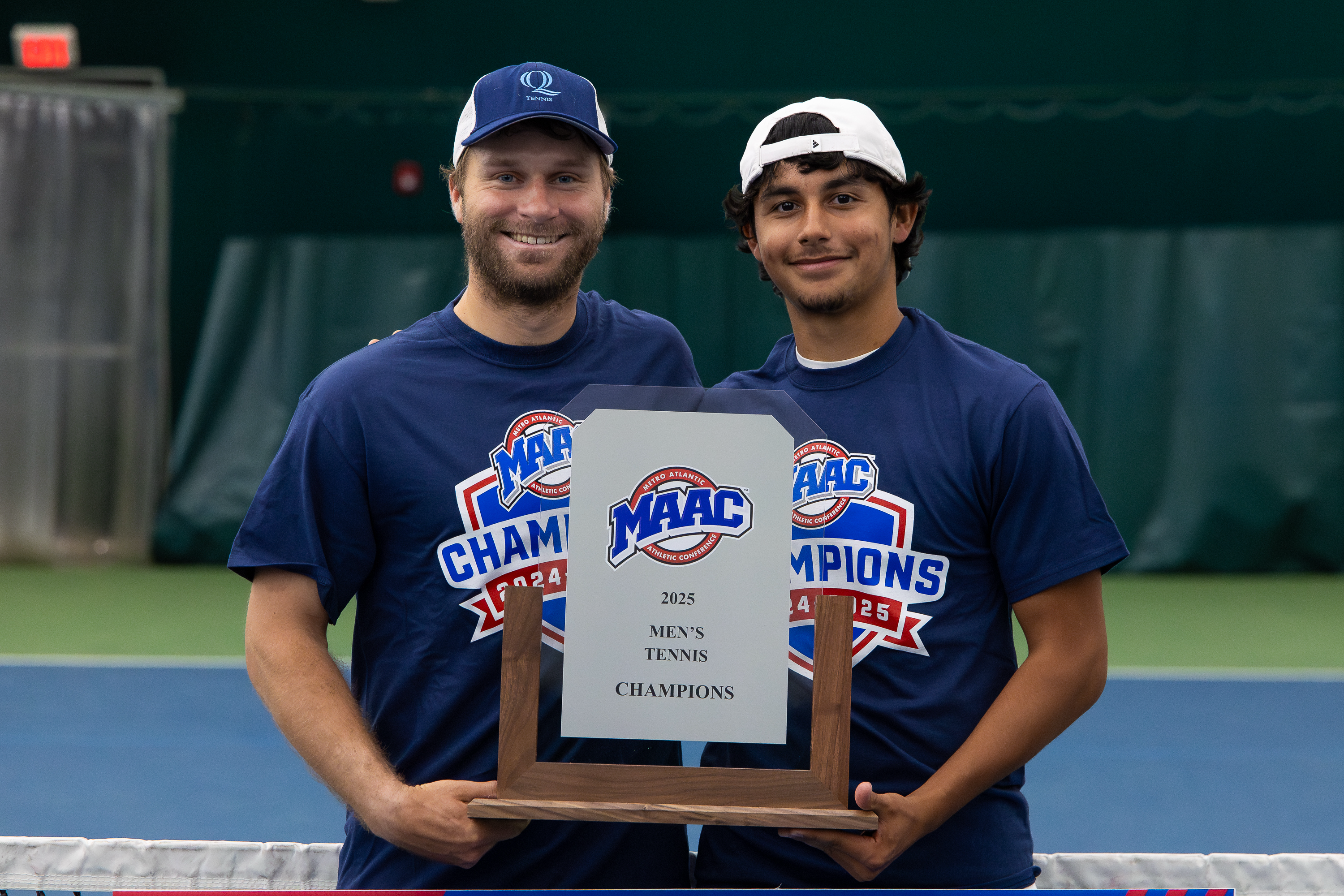
    In sports, every generation sees its share of iconic rookie-and-veteran duos who somehow click. For Quinnipiac’s men’s tennis team, that unexpected spark came from graduate student Daniel Velek and first-year standout James Lorenzetti. 
     
    When the fall season kicked off in September, this duo did not record one win together. But by spring, they were the winning combination no one saw coming. 

    What started as an experiment quickly became the team’s strongest asset. This is the story of how chemistry, trust, and timing turned two individuals into a winning force—and how the rookie and the vet found something more than just success on the court.  

    Meet the Duo:

    Daniel Velek: The Veteran

    Daniel Velek isn’t just a player- he’s a leader. 

    Known for being the loudest on the team and having sharp instincts, Velek is the kind of teammate who makes those around him better. While he played only two matches in the fall, his spring season told a different story: a 9-8 record, including a 6-2 showing in MAAC play. Solid, focused, and consistent – the numbers speak for themselves. 

    James Lorenzetti: The Rookie 

    First year. Big energy. Bigger potential. 

    James Lorenzetti entered the program with hunger and hustle, and it shows. He brings a spark to every match and a sense of fearlessness to every point.While his spring record reflects a tough learning curve, his fall season hinted at what’s ahead: a 3-2 in the fall that showcased his grit. 

    He may be new, but James doesn’t play like he’s afraid to fail. Instead, he pushes, adapts, and brings intensity to the court every time. 

    Chemistry on the Court

    This season, James learned one of the most valuable lessons in college athletics: success is doubled down to more than just skill—it’s about partnership.

    For Daniel, that meant learning patience — something James helped bring out. The rookie challenged the vet, and the vet anchored the rookie. It’s not the most expected match, but it’s one that worked — because they both wanted the same thing to win.

    Despite not clicking in the fall, they quickly left that behind. Their focus was the future. They taught each other lessons that deepened their chemistry, on and off the court.

    Their first time meeting? A quiet, almost forgettable moment at a regional tournament at Yale in fall 2023. James was still in highschool while Daniel was already on the team, as he chatted with James’s parents. But nothing came of it immediately.

    Six months later, James arrived on campus. Their coaches circled back- this time putting Daniel and James together for the spring. What started as a second chance turned into the team’s most reliable duo. While other doubles teams continued to shuffle, Daniel and James stayed locked in — the only consistent partnership all season.

    Their on-court chemistry wasn’t built overnight. Long practices shaped it, shared setbacks, and an understanding that their differences made them better together.

    In Sync

    Despite their age gap, Daniel and James share something more important: the same mindset. They don’t just play to win — they play to grow.

    When I asked them who takes losses harder, they both had the same answer.

    Tennis is as much a mental game as it is physical. Unlike team sports where multiple players can share the weight, doubles tennis demands complete alignment between two people, point by point. One miscommunication or dip in focus can cost the match. That’s why mindset matters. Partners need to be synced not only in play style but also in emotion, energy, and resilience.

    It’s not just about being there during the wins — it’s about being there when your partner misses a shot, loses focus, or hits a wall.

    The Final Match

    At the heart of it all is trust. It’s the unspoken agreement that defines every successful doubles team: “I’ve got your back, and you’ve got mine.”

    For Daniel and James, that agreement has become something bigger than tennis. Their chemistry on the court is built not just on strategy, but on support. Not just on wins, but on willingness — to learn, to adjust, and to show up for each other, day after day.

    What started as a coach’s experiment turned into a championhip-winning partnership. And now? It’s a friendship.


    When asked who would survive on a deserted island, this is what they had to say….

  • The Graduate Student Experience

    The Graduate Student Experience

    The ebbs and flows of collegiate athletics.

    By Sam Vetto

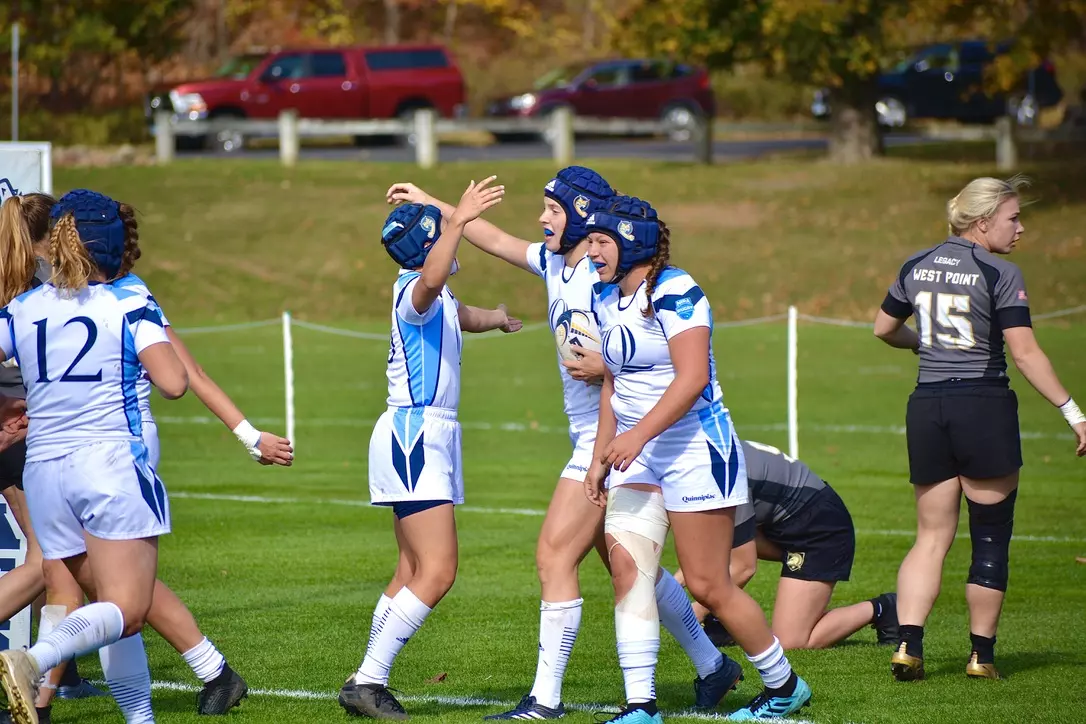
    Quinnipiac Rugby at Army Westpoint
Photo by Kayley Fasoli of Quinnipiac Athletics

    Every summer, thousands of students put on their best clothes, toss on their gowns, and prepare to walk across the stage. This culmination of years of hard work, perseverance, and procrastination has paid off, for that piece of paper collected at the end of the stage. While the average college student has been working to get to this moment, for student athletes it can be a bit somber. 

    For some this is the end of their sporting careers, for others it is where the road just starts. Some seasons ended in triumph at the tournament, but many more ended in heartbreak along the way. Every athlete’s journeys to graduation are very different, but are driven by the same passion, the love of their sports. 

    Reaching the Goal Line:

    Student athletes schedules balance a solid academic workload, while going to practices, traveling for games, doing media appearances, and the like. While this whirlwind of time seems to blow by, the end catches up faster than you think. Before you know it, it’s April, and you are getting ready to walk across the stage. The process of getting ready for the real world can be difficult for the average student, athletes have the added pressures of this potentially being the final ride. 

    “We have a big group of guys going through the same thing, you know you only have a few more chances, just kinda gotta leave it all out there.” said Johnny Knox, graduate student, and second baseman for the Quinnipiac baseball team.  “It’s the only chance you got”.

    “It definitely had its ups and downs,” Anna Van Dyk mentioned, the graduate rugby player has spent most of her college career at Quinnipiac, even being nominated for the 2025 MA Sorenson award for her performance on the Rugby team. “You are trying not to think of the end. We are primarily in the fall, just taking it day by day, but it’s full of emotions.”

    “It’s definitely been sad towards the end, you try to focus on the day to day but it comes up quickly. We had the tournament so we knew going in, that if we lose, it’s done.” said Noah Altman, graduate student and goalie for the Quinnipiac hockey team. “Over the following weeks, the sadness kinda goes away, and you start to look back fondly instead.”

    “I think it’s gonna be weird not having a set athletic schedule. For 5 years, I had team lifts, practice, hung out with the same guys” said Ryan O’Connell, relief pitcher for the Quinnipiac Baseball team, “Shifting all of that team focus to an individual job will be weird.”

    Learning Experience:

    College is a time for development, in every student’s life. You are honing your craft for work in your potential career, building social circles, and learning more about yourself everyday. The athletes are also developing, all of those, plus their skills as an athlete. 

    “How to take things less seriously.” said Altman, “I was always nervous to make mistakes, in class, at the rink. I just remembered, I’m here for a reason, I just have to keep working hard. You get to enjoy times like this only once.”

    “Definitely having your priorities straight, because there is so much you have to balance, with school, athletics, social life. You learn to focus on what’s important.” O’Connell stated. 

    “To take advantage of every opportunity, because they can be taken away very easily.” said Knox, “If you don’t do it, someone else will.”

    “How to be confident.” Van Dyk said, “as well as confidence about failure. When I came in as freshman, I was timid and shy, but through my time here, I have learned to be more confident and take the failures in stride.”

    Sports Wisdom:

    Over the years of competing, there are many harsh lessons that sports can teach us. Every athlete has gained some experience in their sport that has shaped the way they view the world. Whether it be through motivation, hard work, or consistency, sports brings people together, and teaches us about life, in ways we would never foresee. 

    “In a sport so full of failure, it’s important to focus on the positives, being with your teammates, playing hard. Don’t let the little things pile up” said O’Connell.

    “Being resilient, I started at 13 to 14 which is late” Altman said, “I lived in 7 states to play hockey. I had to grow up quickly, moving out at 16, coming to school knowing I wouldn’t play much, but working hard all the way.”

    “Failure is ok”, Knox stated, “you just need to learn and grow from it.”

    “I was alway bigger and stronger than everyone else. As a woman you always receive comments about being ‘manly’, but rugby has taught me to embrace that. I kick ass at my sport, I can be confident. It helped a lot.”

    Memories:

    Across these years, students build up their resumes with experience, but more importantly they make memories that will last a lifetime. For athletes there are tournaments, championships, but even the little day to day moments that will stick with them. These moments spent in college seem fleeting, but truly last forever in the hearts and minds of those who experienced them.

    “Winning championships, it’s something you work for all year, and finally achieving it?” said Knox, “Those are the moments you cherish.”

    “Our coach threw an entire tray of cookies in the trash after a few of the guys were caught eating them on the bench. We got ripped for that one, but it was pretty funny.” stated O’Connell

    “Last year playing Army, they have battled us my entire time here. They always beat us over the three years we played them.” Van Dyk mentioned, “It was a gritty, dirty game, I busted a lip, on top of everything it seemed like it wasn’t going to go our way. But you battle hard and we managed to come out on top.”

    “Winning the National Championship, in Tampa, Florida, its like 86 degrees out there. We stepped outside and saw all the fans and families who had come through. Winning that and experiencing that, I got to go to the White House, went to Fenway and stood on the foul line, it was sick.” said Altman, who competed on the 2023 Quinnipiac Frozen Four Championship winning team. 

    Looking ahead:

    The decision to continue your sport in some way when you are no longer competing in it, is something many athletes struggle with. Some sports are more difficult to continue participating in post graduation, others are very easy to find opportunities, but it is a choice athletes need to make nonetheless. 

    “I hope to one day work in hockey,” said Altman,”By studying Sports Journalism, I can still work in hockey without playing, but I don’t see myself coaching unless it’s for my kids. I love hockey but it isn’t my end all be all plan.”

    “I see myself coaching at a lower level” O’Connell mentioned, “ Maybe Little League in my town or joining a men’s softball league, just something to get out there.”

    “There are options on the table, but I’m kinda all over the place,” Knox said, “coaching is something I have opportunities for, I may look into it.”

    “I do, I am planning on going back home to Colorado, and coaching my highschool,” said Van Dyk, “I am on the USA 15’s, so I will be competing in Brazil, and they are starting a rugby league in the US called the VER, where they have a team in Denver, I would like to play for them someday.”

    What Won’t Be Missed:

    In the ups and downs of college there are always positive memories of teammates and travel, but it isn’t always the easy coast to play-offs that we dream of. Every sport has drawbacks, especially college sports, sacrifices need to be made to compete at the highest level, and these athletes are no different. They feel the difficulties of these seasons more than anyone else, and there will always be parts that are ok being left in the past.  

    I won’t miss taking a shot off my face” said Altman, “I have a love-hate relationship with travel, I love traveling with the guys but getting in at 4 AM is rough. Oh and the hockey smell is the worst.”

    “I won’t miss having to rush from practice to class” mentioned O’Connell, “and the long travel days, being on the road, I’m not a fan of it.”

    “Waking up at 4:30 AM for lifts. It was the only time available, I still dread those wake ups.” said Van Dyk.

    “I will not miss conditioning, and early mornings,” said Knox.