By: Brandon Murdock
In a sport where talent truly has no borders, international scouting is a must. And the head coaches of the men’s and women’s soccer teams at Quinnipiac University have had no issue going outside the country to complete their teams.
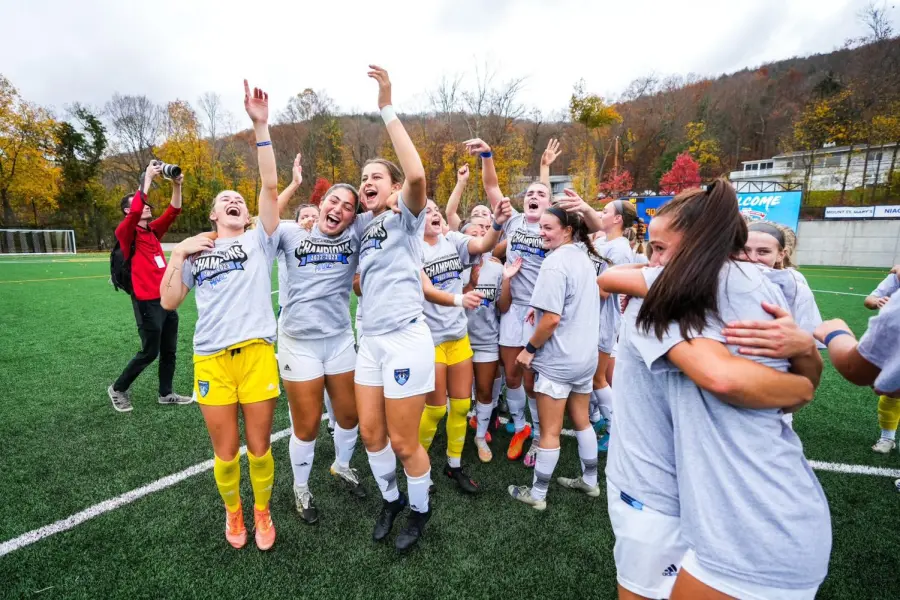
Over the last four years, men’s and women’s soccer have been high-quality programs. The men’s team made the NCAA Tournament in 2022, losing to Vermont in the first round, and made the MAAC playoffs this past year. The women’s team has made the MAAC playoffs every year since 2021, reaching the MAAC championship game this season.
This is the second time the women’s team were finalists during this stretch, the first being in 2021. They went on to win the MAAC and go to the NCAA tournament in 2022 and 2023, losing in the first round to Penn State in 2022 and Brown in 2023.
So how do these coaches find international players?
Seventeen of the 27 players on the men’s team are international, 16 of those players are from Europe. On the contrary, the women’s soccer team has seven internationals, five of whom are from Canada.
Eric Da Costa, head coach of the men’s team, has found success in Europe. He has recruited players from Portugal, Finland, Sweden, Germany, Spain and Norway.
In contrast, Dave Clarke, head coach of the women’s team, has mainly found success in Canada. While over the years he has grabbed players from the Netherlands or Ireland, his focus has been north of the border.
So why do two coaches, who have a lot of success in the same sport, have such contrasting international recruiting strategies?
Inside the Mind
For Da Costa, it’s about finding players that are not only the best that they can get that fit his system, but also fit the culture inside the locker room.
“It’s a little bit of a mix of all we want the best players we can get that fit our system, and more importantly, fit into the culture of the locker room,” Da Costa said.
Da Costa and the rest of the coaches spend a lot of time on Zooms, phone calls and simply just talking to coaches to find their type of players. He wants to get to know families as well to get a good idea of who he is bringing in.
When it comes to on field, he is looking for versatility.
“We love players that are versatile, some players who can play in multiple positions. There’s a lot of interchanging in how we play,” Da Costa said. “So, for a defender to be comfortable higher up the field, or a midfielder to be comfortable in the back line. Players who have that ability to adapt and to interchange positions and still maintain that quality. Those are specific things that we look for.”
Europe being the biggest brand of soccer in the world leads to players learning numerous play styles and philosophies, so it makes sense why the coach sees this region as a fit.
Finally, the accessibility to getting the players over from Europe compared to Canada plays a part.
“We’ve come in and out of Canada. It’s a little bit more difficult,” Da Costa said. “The investment that they must make in the U.S. collegiate education. It’s similar to an American kid, without the financial aid that we get from the government. So, sometimes, finances are the biggest barrier with Canadians.”
Da Costa made it clear that while a player’s fit is important, he wants to make sure he gets players that won’t have as much of a struggle assimilating. This, however, hasn’t stopped Clarke, who over the last few years has primarily recruited from Canada when he goes internationally.
For Clarke, it’s all about familiarity and comfortability. Also, a little bit of help from the school’s hockey program.
Quinnipiac hockey is of course one of the best hockey programs in all of college hockey, rostering Canadians of their own on the team. So the name “Quinnipiac” is not too new to those in the country.
Clarke recalls a time he was recruiting in Canada. He was at a soccer facility, right next door to a hockey arena, and he got a lot of love. He was wearing a Quinnipiac jacket, and many of the people started buying him drinks and snacks thinking he was a part of the hockey program.
To say the least, the name carries.
“They all tend to want to come to the U.S. anyway for school,” Clarke said. “But once you have that network, and we’ve had that network, you know, we built up a good rapport with some of these schools. We have four to five Canadians coming in as well. But the other thing too is we’ve looked after them.”
While this hasn’t stopped Clarke from going to Europe himself, it is clear to see the mindset of why he makes so many frequent trips north of the border.
Boots on the ground
Now that we’ve seen what leads these coaches to recruit in certain areas, what does a day on the international recruiting trail look like?
They both discussed how it’s a lot of early mornings and long nights. Their days can run from 8 a.m. to 8 p.m.
A lot of coffee and early flights is a common theme for these coaches to keep them going for recruiting that truly takes all day. Da Costa emphasized how they have to maximize their trips.
“We try to maximize the investment as best we can.” Da Costa continued. “We can’t afford to make mistakes. We just can’t. We’re not a program that is funded that way, and we need to, we need to get it right.”
Quinnipiac being a mid-major university doesn’t make it easy to travel as freely and take chances. Da Costa and the rest of the staff go to larger events to be able to see as many players as they can in the time that they have. They go from country to country and sometimes can take 24-hour day trips to Europe to get the right player.
He knows the budget he is working with, so he knows that he has to allocate time and resources appropriately to give the program the best chance for success.
For Clarke, it is a similar story as the long days include travelling from location to location trying to find the players that fit. Clarke sang a similar tune to Da Costa as he knows he has to be smart with his time and resources and maximize the trip the best he can.
“You’re trying to do budgeting,” Clarke said. “It’s many games in a short period of time, sometimes it’s two or three games in a day.”
What’s your story?
It is clear the day-to-day grind is real for these coaches when it comes to recruiting internationally, but what is it like from the players perspective?
From the men’s side, first-years Fynn Ost and Sivert Ryssdalsnes have different experiences compared to domestic recruiting.
Ost, who hails from Ebersbach, Germany, didn’t go through the typical club circuit you see in America, instead he tried to go through an agency that specializes in college recruiting, which wasn’t to his liking.
“I wasn’t really happy with my agencies, so I did part of it on my own and reached out to some coaches, and that’s how I got in touch with Eric [Da Costa],” Ost said.
Ryssdalsnes, who comes from Asker, Norway, has a similar story.
“What’s normal in Norway is like you reach out to the big company that works with recruiting athletes in general to the United States and college, so they have a lot of contacts in the U.S.,” Ryssdalsnes said. “Then you sign up with them, and then they go talk to different schools, and different schools reach out to me, and then I just decide which school sounds the best to me.”
In the U.S., kids typically are not able to go through agencies to find a school. They usually play club soccer and just get scouted from tournaments and games from that.
On the women’s side, Racquel Alexander and alumni Markela Bejleri have their own experiences
For Alexander, who is from Markham, Ontario, Canada, it was familiarity that helped make her decision.
“I found out about Quinnipiac because another player that had played for my club that I was really close friends with came here,” Alexander said. “So that kind of like put it on the radar for me.”
The process for Alexander was more atypical for recruiting in the U.S.. The then-assistant coach, Steve Coxon, spoke with her and Clarke a lot both in person and over Zoom. They went out to Canada to see her play, going to a few tournaments and before signing her.
Bejleri, who is from Toronto, has a similar story.
The process started early in high school and Bejleri traveled with her club team to tournaments that college scouts were at. Like Alexander, she met with both Coxon and Clarke at one tournament and eventually came to campus.
“After that tournament, the process really started as I went on a visit, toured campus and met Dave,” Bejleri said.
The Canadian way of recruiting mirrors the U.S. much more than the European path does. Either way, they both found their way to Hamden.
But when these coaches do their international recruiting, what kind of style are they seeing?
The game across the globe
For Ost and Ryssdalsnes, they feel that the game in Europe is more controlled and is played at a slower pace compared to the game here where you see a lot more physicality.
“I think it’s just a European thing. It’s more controlled, more tactic-based in Germany. Here it’s more transition,” Ost said. “A lot of running and a lot of physicality. Just knowing how to deal while you’re exhausted with the soccer.”
Another difference would be the length of the season. Where the schedule in the U.S. is more compact and shorter. In Europe, it’s easier weeks but a longer schedule.
“During the season it’s games Monday, Thursday and Sunday, like twice a week, or even three times a week,” Ryssdalsnes said. “But in Norway, the season is much longer, but we only have one game per week, so that’s probably the main difference.”
The length is certainly something to get used to.
The brand of soccer is similar in Canada to the U.S. as the pace of play is equal, despite the compete level being a bit higher here.
Another difference would be the travel as the distance between schools in Canada is greater than here.
“You have many schools in one small radius, so you only have to travel like 30 minutes to get to Fairfield, for example,” said Alexander. “Whereas at home, for some of the games, they have to travel like four hours on the bus one way, and four hours on the bus past the school to go somewhere else just because it’s a lot more spread out.”
For two countries, being the U.S and Canada, where soccer is not the main sport, it is certainly growing and starting to catch up with the rest of the world.
“On a more senior level, I think soccer in both countries has grown massively, with many players continuing to play at the highest level even after graduating college,” Bejleri said.
While the style of play may be different and the recruiting grind is treacherous, there is always a method behind the soccer programs’ madness.